

Print Issue Archive
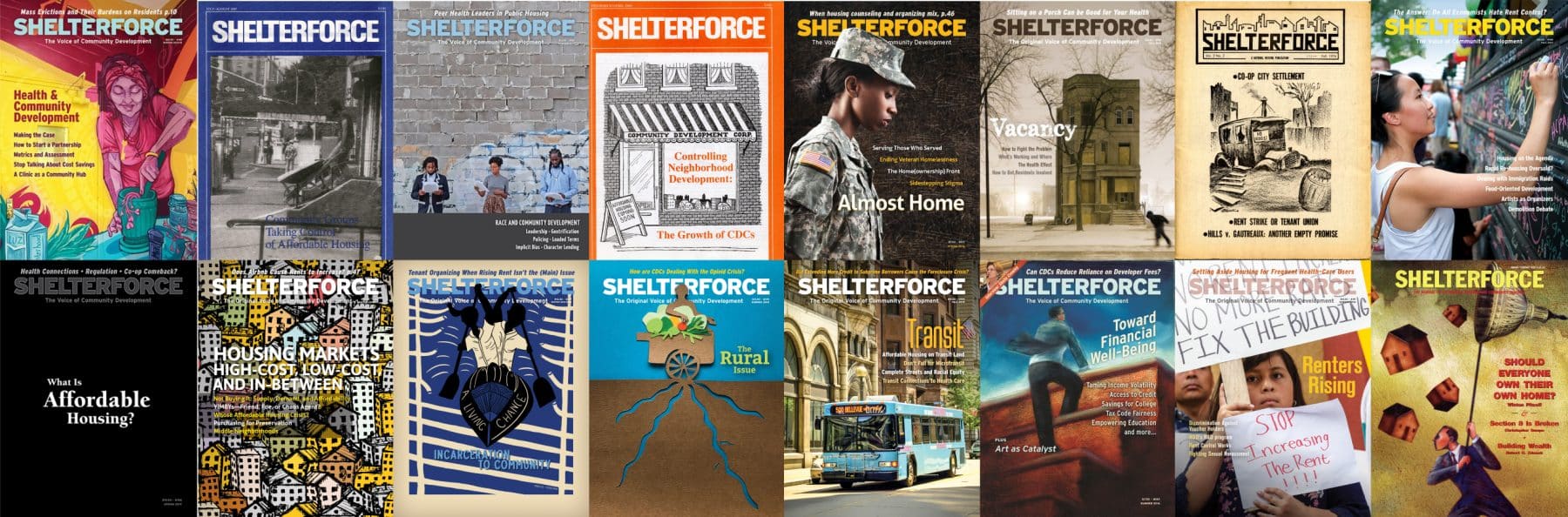
Shelterforce published in print from 1975 to 2020. All of the issues back to 1994 are fully digital and collected here for you to browse by theme or date. To read themed series from 2020 on, visit the Under the Lens page.
Incarceration to Community
Mass incarceration is a major influence in American society. But like so many other things, its effects are not evenly distributed.
In this issue we bring you a small sampling of areas where the worlds of criminal justice reform and community development intersect.
Read the Issue Transit
It should be no surprise that transportation access is the No. 1 factor in lifting adults out of poverty, an often overlooked finding from the last several years’ wave of big data research into economic mobility, or the lack thereof, in this country. In this way, the question of transportation is directly bound up with the work of community developers, who are trying to further healthy communities and opportunities for people who have been marginalized.
Read the Issue The Rural Issue
Our default frame of reference has tended to be urban areas (“cities” or “metros”), with a feeling that rural was a baffling “other thing” that we didn’t really understand.
It’s true that rural areas have different needs, contexts, and challenges. But so do hot-market and Rust Belt cities, central cities and inner-ring suburbs, massive cities and smaller ones, and we consider all of them within our usual purview. It was time to shift our thinking so rural areas were more clearly part of the fold, and we decided that a focus issue would be a good way to do that.
Read the Issue Resilience
Resilience isn't a new term. We’ve kept looking at it, because, of course, it’s not as if disaster preparedness and recovery, environmental quality, and working across sectors are not crucial issues, no matter what you call them. In this issue, we take a look at resilience, why we need accurate maps to increase flood resilience, designing for climate change, and much, much more.
Read the Issue Housing Markets
After the housing crash of 2008, one of the pieces of wisdom many people said we had learned from it was that there wasn’t “a national housing market,” but rather a whole bunch of very different regional markets and neighborhood submarkets.
Like many lessons, it may have only been partially absorbed, however. Thanks to the big-data work of researchers like Raj Chetty, there is significant widespread understanding about the vast differences in life outcomes that statistically come with different neighborhoods. The housing markets in these regions and neighborhoods also differ.
And yet, as prices skyrocket in popular, high-profile cities (and a small handful of neighborhoods in other places), there's a growing assumption that that’s what’s happening, or about to happen, everywhere.
In this issue we look at many different kinds of housing markets and their implication for our work.
Read the Issue Vacancy
Rarely are abandoned buildings and dumped-on lots counted in the asset category. And no surprise—they are damaging to the community around them in myriad well-documented ways. They harm the health of nearby residents, as well as their quality of life, and at some point if there are too many abandoned buildings, they can seriously hamper the ability of a neighborhood to function.
And yet, thinking of abandoned properties as merely problems we wish would go away, rather than opportunities that we need better tools to access, feeds into some of the less productive ways vacant properties have been handled over the years.
Read the Issue Renters Rising
With the much-belabored and fretted-over rise in the proportion of renter households after the foreclosure and financial crisis has also come a resurgence of tenant organizing—or housing justice organizing as many groups are calling it. Rent regulation is no longer being discussed as a vestigial holdover from a previous age, but again actively debated and organized for.
Read the Issue Permanent Affordability
In this issue we also take a look at where models of permanent affordability and shared equity stand now, how they have fared over time, and how they could be or are being expanded into new places —even some places where the existing community development organizations weren’t so excited to see them coming.
Read the Issue Health
It seems as if everyone is talking about the intersection of health and community development. And yet, the actual work is mostly at the beginning stages.
In this issue, you’ll find articles that will help you make the case to potential partners and funders about why you all should be working at this intersection, explore how community development and health care sector partnerships work, examine how the community development field is changing its own practices, share the latest innovations in metrics and evaluation, and promote good policy that supports this work.
Read the Issue Community Development Potpourri
This issue represents a great cross-section of the variety of what community development is. In here we have stories of organizing, housing, health, and arts.
Stories of affordable housing challenges in strong markets and weak markets. We have policy, program, and resistance; fighting homelessness and lending to for-profit developers; stories and data, partnerships and individuals; and people and place.
Read the Issue Racial Justice
Working directly or indirectly to fight racial injustice is a large part of what the field does. And yet, that doesn’t get us off the hook. We need to examine our organizations to determine whether we are falling short of advancing racial equity and inclusion.
It can show up in the way we stick with hiring practices. It can show up in racially loaded language like “inner city” or “urban pathology”. It can show up in uncritical adoption of measures with historic disparities built into them.
Read the Issue What is Affordable Housing?
What does housing affordability mean? We bring in the history, the challenges, the different contexts, and the many ways to define what having “enough” means to provide a comprehensive look at this fundamental question.
In this edition, we delve into issues like why we measure housing affordability the way we do, and does it make sense; how we define who is “low income” and what counts as having “enough” income to meet your basic needs; and whether “naturally occurring affordable housing” is really natural.
Read the Issue Art, Culture, and Community Development
In this issue, we look at the ways that arts and culture work can be brought into and more systemically applied to place-based community development work. This intersection is by no means new—it been around for thousands of years. But the election has also elevated the urgency of some other roles for the arts—in energizing resistance; in changing hearts and minds; in helping people overcome a fear of the other; in comforting the afflicted and afflicting the comfortable; and in maintaining a moral center in the face of big lies and swirling chaos. These too are not new roles, but we are going to need them a lot in the coming years. Creative protest and thought-provoking political art has been part of every crucial movement for justice.
Read the Issue A New Look at Economic Development
In this issue, we focus on equitable economic development, with an increased focus on the role of the public sector. After all, billions of taxpayer dollars are spent every year to stimulate economic development.
Is it going where we think it’s going? Can we find ways to make use of formerly obscure federal sources of funding? Are big economic development investments generating the results we want, and how do we measure that? The answers are not always easy.
Read the Issue Financial Well-Being
What does it take to achieve financial security for the millions of American households without it? Clearly full employment, higher wages, and a more robust safety net would be some major components.
But as important as those are, they aren’t the full picture.
In this issue, we tackle perceptions that asset-building is mostly about behavioral change for low-income households, explore the problem of income volatility, look at structural issues that reproduce financial instability, and talk about some solutions and campaigns.
Read the Issue Mixed Income
It's a common goal of redevelopment to promote economic inclusion by mixing incomes within a new development. While you'll find little argument about economic inclusion in general, there can be some significant differences of opinion about how, why, on what scale, and at what cost.
In this issue we explore many sides of those questions, looking at developments from San Francisco to the D.C. area.
Read the Issue Julián Castro: Secretary, U.S. Dept. of Housing and Urban Development; Special Section: School Reform
School reform has become one of the most hot button issues of the day, polarizing people who would otherwise be political allies.
This issue focuses on school reform and community development, and what we need to know about charter schools, education work involving real estate, and more. Plus, an interview with HUD Secretary Julián Castro
Read the Issue Looking Toward Resiliency: Equitable Disaster Recovery in the Era of Climate Change
In this issue we take a look at a few of the lessons and challenges that are emerging for those who care about equity in the era of climate change. In “The Justice Gap,” New Orleans–based reporter Katy Reckdahl shows us how crucial legal services are in the face of a disaster like Hurricane Katrina. In “Detours on the Road Home,” M. A. Sheehan walks us through some very concrete ways in which a recovery program like Road Home can better serve those who need it most. And in “Rising Tides, Rising Costs,” we learn about one of the next frontiers of equitable disaster preparedness—dealing with skyrocketing flood insurance rates for those who have long been pushed into flood plains.
Read the Issue Immigration
The story of neighborhood populations changing with waves of migrants is a classic part of the history of American cities. In this issue we have collected some introductions to the context of immigration patterns in the United States, and then explored some of the ways in which the community development field is encountering and addressing immigration issues explicitly, from citizenship loans to partnerships among different ethnic-focused organizations to supporting immigrant entrepreneurs to going multilingual.
And we have another article in our economic development series that explores the question of whether organizations that are supporting economic development, through lending or technical assistance or planning, can weigh in about the quality of the jobs created in the projects they support.
Read the Issue Aging in Community
Our housing stock and our communities are not ready to accommodate the needs of the coming age wave. Most of our housing stock is not adapted for the challenges of aging, and our health care system is only taking the first baby steps toward thinking about prevention. This puts us in danger of having an overwhelmed system in which the lives of too many seniors, espeialy lower income ones, are isolated, curtailed by preventable falls, or disrupted by premature moves and institutionalization. The good news is this is a challenge for which we have the chance to fully prepare. We know more or less exactly what's coming and when. We also have a pretty good grasp on what needs to happen and his issue of Shelterforce explores many of those things.
Read the Issue Almost Home: Caring for Our Veterans
Veterans seeking help from community housing providers are told to go to the VA. But that generally means a Veterans Administration Medical Center—a health care provider, not a specialist in housing. It’s time for more coordination between the community development field and veterans groups, and many of the articles in this issue speak to just that, whether it’s CDCs learning how to better serve vets, a community land trust offering VA loans, or all the homeless service providers in a city working as a team.
Read the Issue The Work Issue
Rising income inequality and poverty levels make the goals of stabilizing distressed neighborhoods, increasing equal opportunity, and making a healthy home and neighborhood accessible to all many, many times harder. But despite the challenges, there are practitioners who have been supporting economic development in communities in need all along, whether it’s the community development financial institution field financing small businesses, community land trusts developing commercial space, or CDCs focusing on who builds their housing as well as who lives in it.
Read the Issue Impact Investing: Will It Bring New Money to Old Problems?
This issue has been designed to introduce you — policymaker, advocate, or practitioner working to improve distressed communities and empower low-income families — to the field of impact investing and to help you understand how such investment might work, how it might affect your work, and what you should do to take advantage of these new sources of capital.
Going beyond our readership, it is also designed to introduce the potential for impact investing domestically in the community development world to a broader audience of potential investors, showing them what community development is and how it would benefit from their investments.
Read the Issue Redevelopment: Can We Get the Good Without the Bad?
In any field, there are certain story lines and beliefs that are repeated over and over. But if you pay closer attention, you’ll find that reality is almost always far more complicated, and assumptions are being disproved left and right. The articles in this issue challenge many of the assumptions prevalent in the community development sector.
Read the Issue Time to Rethink the CDC Model?
Time to Rethink the CDC Model? What is a CDC? Many a meeting among those in the field has descended into argument about what is inside and outside the line. It was inevitable that in designing a focus issue on the “CDC model” that we would be asked to examine that question as well. Shelterforce takes a very expansive view of community development. We believe it can encompass anyone working to create healthy communities in low-income neighborhoods and empower their residents.
Read the Issue Hearts of the Neighborhood: "3rd Places" in Our Communities
Third places are those gathering places that are neither home nor work. They have tremendous importance for the vitality of our communities. This issue looks at many aspects of how they are created and sustained.
Read the Issue Voting Block: Neighborhood Voting Rights
Joining the fight to maintain voting rights and voter power in your neighborhoods and for your constituencies may seem like an additional burden on an already overfull and underfunded plate. Articles in this issue show how it’s the foundation to getting your issues on the political agenda, preserving the advances being made at the federal level, and electing officials who understand your work and will help your neighborhoods from the inside. We also look at two instances of NIMBY, and what happened when the developments protested against were built.
Read the Issue Health
Are Our Neighborhoods Making Us Sick? This issue examines the idea that our ZIP code determines our health and life expectancy, with an author roundtable featuring Philip Tegeler, Sister Lillian Murphy, and Mindy Fullilove. Also, articles on philanthropy and healthy housing, the role of ill health in foreclosures, and an interview with Sen. Robert Menendez.
Read the Issue Capital Markets
For most of this issue, we look at the community development field as players in a marketplace who might have some points of commonality, or even partnership, with private equity firms, hedge funds investing in real estate, or for-profit developers scooping up foreclosed homes to turn into rentals.
As this capital enters our neighborhoods, it is time to not only organize, but to also step up and participate in the market, bringing our field’s strengths, connections, and know-how to make sure new investment doesn’t just wash further equity away from the places that have suffered the most. Though we come to the table as strangers (how often do you make deals with hedge funds?), we should do it not as supplicants, but as peers, and potential partners.
Read the Issue Holding Banks Accountable
Lenders and servicers must be, and can be, partners in neighborhood stabilization. But even as there is partnership potential, the power relations between affected communities and financial corporations are still severely imbalanced, and communities continued to be harmed. In this issue we hear from those trying to pile on the scales on the side of communities, seeking what Michael McQuarrie has described as the “respect and recognition that comes from successfully negotiating an outcome to a confrontation — something that can never be achieved when confrontation is off the table.”
Green design lowers utility bills, repair and replacement expenses, and healthcare costs. Locating near transit and in denser, opportunity-rich areas lowers residents’ transportation costs and increases their access to jobs and other opportunities for self-sufficiency. Along with making a stronger, more just society, these improvements strengthen local economies and save taxpayers money from other pots. We have a set of articles in this issue that we look into how those two sets of goals are being pursued in tandem.
Read the Issue 36th Anniversary
This issue marks our anniversary, but in a different way.
When we mark the passing of time, we often look back. This is necessary and valuable. But progress comes when new ideas are born and nurtured to fruition, and when the enthusiasm, commitment, and insight of young leaders is let loose . . . the way it was 36 years ago.
And so for our 6 times 6 anniversary, we invited six exceptional young community development leaders to describe how they see the CD world and what’s needed to turn every place into a community of opportunity. They come from different parts of the country and represent some of the rich tapestry of America. They are accomplished, determined, and optimistic, while dealing with today’s realities head on.
Read the Issue Fair Housing: The Work Continues
Along with a cover package on fair housing and the continuing fight for equity, this issue features an interview with HUD Assistant Secretary for Fair Housing and Equal Opportunity John Trasviña.
Read the Issue Affordable Housing and Transit-Oriented Development
This issue's cover package starts with an overview of transit-oriented development projects and the ways equity advocates are shaping station-area plans, and it ends with a piece on policies that can help move that along. In between, we take an in-depth, three-article look at what’s happening in Atlanta, where the BeltLine has spurred a creative idea on how to bring community land trusts to scale.
Read the Issue The Road to Neighborhood Stabilization
Policy can have a hard time drawing the attention of action-oriented practitioners.
Those of us who care about building healthy communities want to get those buildings rehabbed, the predatory mortgages modified, the deals closed, the tenants organized, the park cleaned up, the new library opened.
Whether we are swinging the hammers or doing the people work behind the scenes, those concrete projects with tangible effects are what make our hearts sing.
But of course, everything we do happens in context, and the ways in which our laws, funding streams, and program models are constructed have a huge amount to do with how successful our individual projects are, as well as how well they move us toward our larger goals. Many of the articles in this issue remind us of this.
Read the Issue Public Housing: Preservation or Privatization?
To do the hard work of building and preserving neighborhoods of opportunity for all, we must look honestly at challenges and opportunities lost, analyze the opportunities in front of us, and understand our successes while celebrating them. Shelterforce does all this — as in this issue, from its sobering look at the growing affordability gap to the exciting story of Cleveland’s Evergreen Cooperatives to our cover package on the pitfalls and promise of the Preserving, Enhancing, and Transforming Rental Assistance (PETRA) proposal.
Read the Issue Organizing Post ACORN
Barney Frank, chairman of the House Financial Services Committee, says that a real solution to the housing crisis will only come when organizations “join together and advocate for the resources” needed. He encourages advocates to “promote cutting the military budget and raising taxes on rich people,” as the only real solution — a solution that requires mobilization, he says.
But where will that mobilization come from? In this issue we feature a group of articles that look at the challenges to effective organizing and profile two successful organizing groups.
And we talk with Frank, about consumer protection, the future of Fannie and Freddie, the role of FHA, and more.
Read the Issue Shelterforce interviews Shaun Donovan, secretary, U.S. Department of Housing & Urban Development
A special double issue, featuring an interview with Shaun Donovan, and articles on Memphis, Minnesota, New Jersey, Chicago, Washington, D.C., and other places.
Read the Issue Throughout this issue we look at how communities use stimulus dollars to create equitable and sustainable change. Is the stimulus, along with the 2010 budget funding, allowing for the implementation of real neighborhood preservation strategies? Are communities forming enduring collaborations, or are they collaborating to satisfy grant requirements? To set the stage, we’ve asked 11 leaders in the community development world to weigh in on the stimulus, how it plays out in our communities, and how it needs to improve.
Read the Issue Foreclosure Crisis
Neighborhood Stabilization and the Foreclosure Crisis.
Read the Issue Coming Up for Air: What Housing and Community Developer Practitioners Need to Know to Survive the Economic Deluge
Coming Up for Air: What Housing and Community Developer Practitioners Need to Know to Survive the Economic Deluge.
Read the Issue From Grassroots to Oval Office
From the Grass Roots to the Oval Office: Some of the nation's leading community development thinkers and practitioners weigh in on key issues leading up to the 2008 presidential election.
Read the Issue What Green Means
What Green Means for Communities.
Read the Issue Course Correction: John Atlas, Peter Dreier, Michael McQuarrie, Pat Morrissy, Todd Swanstrom, and John Taylor on how to gain traction and steer us out of the mortgage mess. Plus: Making eminent domain work for communities
Read the Issue Community Development at 40
Forty years ago, Sen. Robert F. Kennedy spearheaded legislation to create the nation’s first community development corporation, Bedford-Stuyvesant Restoration in Brooklyn, N.Y. This issue of Shelterforce marks that milestone by examining the CDC movement at 40, exploring its changes, challenges, and innovations.
Read the Issue Housing and Presidential Politics
In this issue, Peter Dreier, Barbara Sard, and Greg Squires point the presidential candidates in the direction of some promising strategies for redressing income inequality and the structural roots of residential and school segregation.
Read the Issue Subprime Slide
Subprime Slide: Has the foreclosure crisis knocked affordable homeownership off its foundations?
Read the Issue Shared-Equity Homeownership
Bringing Shared-Equity Homeownership to Scale
Read the Issue Community Control: From Participatory Budgeting to Neighborhood Planning
While participatory budgeting is not uncommon in many parts of the world, the movement is only beginning in North America. This issue looks at efforts in Lawrence, Massachusetts; Chicago, and New York's Chinatown; and at how some CDCs are discovering both the challenges of neighborhood planning and the rewards. In all cases, community organizing and collaboration were vital to the creation of successful plans.
Read the Issue After Katrina
This year, Shelterforce is looking at the direct consequences of Hurricane Katrina and what it means for community development as a whole. In this issue, we present a group of articles that provide an overview of the politics, planning and organizing that preceded and followed the hurricane. Also in this issue, an article about a downtown Oakland housing development aimed at stemming the gentrification being encouraged by the city’s mayor.
Read the Issue 30th Anniversary
30th Anniversary of Shelterforce: Looking Back, Looking Forward.
Read the Issue Coming Home
In this issue, we spotlight the growing need for supportive housing for ex-prisoners re-entering the community.
Read the Issue Neighborhoods, even public housing neighborhoods, are flesh and blood communities. When neighborhoods are torn, culture and memory are ripped apart. As we “revitalize” these places, we must be ever aware of what’s really in front of us and how deeply go the roots of all communities.
Read the Issue Whether we want to put housing on the agenda or progressives in office, whether we want to break down barriers or increase opportunities, collaboration and engagement are the only true roads to power.
Read the Issue Articles in this issue explore the human and political consequences of a public policy that rewards the rich, punishes the poor, and makes “opportunity for all” an empty phrase.
Read the Issue Playing Arena Politics
Articles in this issue look at Ronald Reagan's legacy, as well as Mel Martinez's record of achievement, if any, as HUD secretary. Also, a housing bubble and what it means for the rental market.
Read the Issue Beauty in the Bronx
How can we build housing for low-income families that is more like home? That might sound like a lot to demand of mere bricks and mortar, but it is consistent with the broad range of activities that we call community development. Unemployment, poor health, unsafe housing conditions, inadequate education and discrimination all chip away at our ability to make a home. What would it take for us to build housing that fostered a sense of well-being? And where would we begin?
Read the Issue Enterprising Nonprofits
A growing number of nonprofits are moving away from dependency on government and foundation support and toward the market. We profile Housing Works in New York City, which has launched a series of businesses that now account for 85 percent of its funding. Also, articles on redeveloping brownfields, housing policy, and more.
Read the Issue New Rules for CDCs
Sink or Swim: A changing community is just one factor that may prompt a CDC to reexamine its tactics and mission. Sometimes it might make sense to collaborate with another CDC, the better to pool resources and personnel in pursuit of a shared goal. In another instance, merging with another CDC might be the only answer when two groups are locked in competition for dollars from the same shrinking pool of funding sources. In extreme cases of economic mismanagement, poor planning or loss of funder and community confidence, shutting the doors forever may be the only option. In this issue, we look at CDCs that have flamed out, and two that merged. John Atlas and Peter Dreier deconstruct an attack on ACORN offer their appraisal of ACORN’s accomplishments, and why it has succeeded where others have failed. Also, we hosted a roundtable on gentrification for PBS.
Read the Issue Discussions of poverty and what to do about it tend to focus on hard numbers and thresholds: How many households live below the poverty line? How many families spend more than 30 percent of their income for housing? Hard targets make for clear goals. Build a hundred affordable homes and you reduce the number of Americans who must strain to keep a roof over their heads. Organize a community to pass a living wage ordinance and you raise the income of a thousand families.
But all the housing production programs we could finance and all the living wage ordinances we could pass will not eliminate the need. We must work on not only reducing poverty but also addressing its effects. ... The most debilitating symptom of poverty may be its impact on opportunity.
Read the Issue Times aren’t easy for housing advocates. But a dose of perspective can be healing. The basics of community development have always included organizing and collaboration. And this work has gone on before, more often than not, with grudging and minimal federal support. At the low points, like now, we need more than ever to remember and reinforce our fundamental strategies and strengths – and the successes they bring. The articles in this issue remind us that, in the face of numerous challenges, community-based organizations are persevering, and that our deepest-held principles of community organizing and empowerment endure.
Read the Issue Evaluation
Evaluation is perhaps the most loaded, and often the most feared, word in a community developer’s vocabulary. Done well, evaluations require organizations to define what they care most about, align stakeholders around those values, enable them to know whether they are achieving the impact they seek, and communicate that impact to community constituents, funders and policymakers. Increasingly, community builders face new and tougher questions: “So what? Did it end poverty, improve quality of life, foster self sufficiency? How do you know?” Equally challenging is the question, “Is your approach cost effective?”
Read the Issue Schools and Communities
This edition of Shelterforce examines the possibilities and challenges facing communities as they begin to address the problems that plague their schools. A topic as broad as education demands far more attention than a single issue of a magazine can provide, however, so this is only a beginning for us as well.
Read the Issue Focus on Faith-Based Initiatives
Faith-based organizations are being called on to do more than ever, but the kind of progressive activism needed to fight poverty and injustice will never be funded by a Bush administration. It is up to us to move beyond the myths our authors dispel lest our nightmares become reality.
Read the Issue Leadership
In this issue's collection of articles, we examine leadership from a variety of perspectives. In each, however, we find one key element - the nurturing of what the academics call human capital.
Read the Issue SPECIAL ISSUE: Shelterforce's 25th Anniversary! Essays on history, policy, and strategies from asset building to organizing for power.
Read the Issue As the turn of the millennium approaches, millions of children go to bed every night in unsafe, overcrowded, or unaffordable homes, along with hundreds of thousands who sleep on the streets. Very depressing. This issue gives readers reasons to be hopeful, among them, living wage ordinances in a growing number of cities; promising steps toward community empowerment in Seattle; and the preservation of the CRA despite attempts to weaken it.
Read the Issue In this issue, we look at some programs that have succeeded in providing appropriate training for low-skilled people while linking their graduates to jobs in the local and regional economies. Also, two writers look at the central issues of community organizing:
How do we overcome entrenched attitudes and politics? Around what issues do we organize? To what extent should we embrace organizing around identity or class?
Read the Issue The articles in this issue show by example and opinion a range of work collectively known as organizing. While we by no means discuss the complete organizing universe, we explore many different types of organizing – from confrontational to consensus and from issue-based to identity-based. Each of these articles sheds light, we hope, on the how of organizing – its accomplishments, pitfalls, and potentials. Perhaps less obviously, most of the articles also grapple with the questions "why do we do it?" and "how can we do it better?
Read the Issue Our 100th issue looks at some of the successes of the preceding 23 years, and the challenges that remain. Today's battles include drugs, massive central city disinvestment, lousy schools, growing income inequity, and a weakening of the social bonds that hold us together, along with unlivable and unaffordable shelter. One hundred issues ago, the Shelterforce Collective had it right: the key to victory remains in the neighborhood – in the hands of organized residents, innovative leaders, vital community institutions and associations, and all those committed to justice.
Read the Issue In this issue, we look at two fundamental steps beyond housing that build community – creating decent schools and assuring that jobs offer family-supporting wages.
Read the Issue In this issue, we explore the challenges of welfare reform from the perspective of community organizers and housing activists.
Read the Issue This issue looks at two trends in poverty alleviation that address major shifts in the nation's economy and political life. First, a focus on regional development, and the second of two articles on Comprehensive Community Initiatives (CCIs) around the country, which are working to harness the often overlooked skills, energy, and ambitions of those living in low-income communities.
Read the Issue Saving Affordable Housing
Special Issue: Saving Affordable Housing
What Community Groups Can Do & What Government Should Do
by John Atlas and Ellen Shoshkes
A National Housing Institute Study
Funded by the Ford Foundation
Read the Issue In this issue, we feature housing news from Santa Fe and Pittsburgh, and offer some nuts-and-bolts information on how housing advocates and nonprofits can prepare for the 1996 president election season.
Read the Issue Issue-focused organizing, collaboratives, bricks & mortar development – all offer challenges and opportunities. Is there a best way? Many organizations began as neighborhood groups organized against something, but over the years, however, their agendas changed. As groups became increasingly involved in the physical rebuilding of their communities, they abandoned confrontational strategies in favor of negotiation and partnering, often with the very people they once protested against. Among development groups that want to return to or begin organizing, the resulting departmental tensions may turn self-defeating. This issue looks at an alternative model for community organizing, and collaborative efforts to bring about change.
Read the Issue 20 Years of Shelterforce: While the past 20 years have borne the erosion of community, it has also been a time of growth and learning within the housing and community development movement. Those of us in the community building business share a vision and a commitment to re-weaving the fabric of community in cities and suburbs alike.
Read the Issue Community Building and Neighborhood Change
This issue looks at HUD's proposed rules affecting the affordability of housing for over 1 million low-income families. Chester Hartman interviews William C. Apgar Jr., executive director of Harvard's Joint Center for Housing Studies, on his recently completed study for HUD on how to reform the FHA. Also, organizing in colonias on the Texas-Mexico border.
Read the Issue This issue is a roundup of opinion on the recent sea change in American politics, including articles by Jesse Jackson and New York Times columnist Bob Herbert.
Read the Issue Health Sector 101
Housing is health care. The truth of that statement is clearer now than ever before. But as we’ve found in our coverage of health and community development over the past couple of years, knowing that partnering with the health sector is a good idea and understanding how to do it are two different things.
Over the next several weeks, we’ll talk about some of the parts that often don’t get said—Who are the players in the health sector, and what are their incentives to address social determinants of health? What is the difference between public health and medical care? How do partnerships get started? We hope these articles will give community development practitioners the context and the confidence to forge new and better partnerships with their health sector counterparts.
Read the Issue