


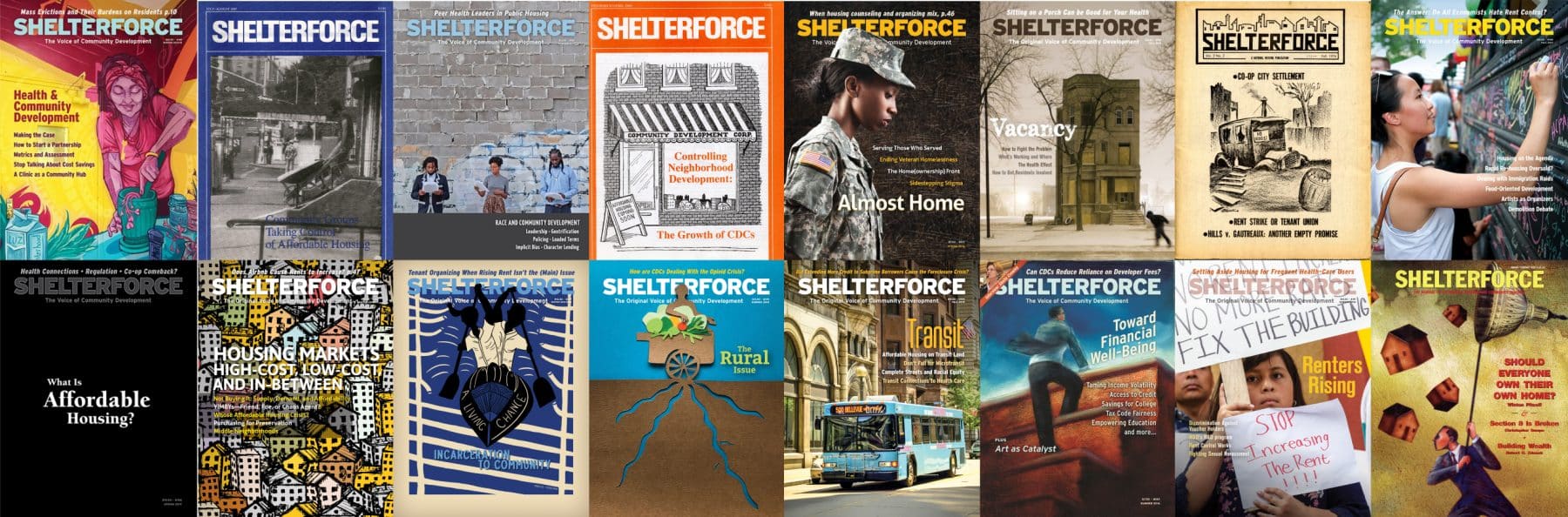
Print Issue Archive
Shelterforce published in print from 1975 to 2020. All of the issues back to 1994 are fully digital and collected here for you to browse by theme or date. To read themed series from 2020 on, visit the Under the Lens page.
Incarceration to Community
Mass incarceration is a major influence in American society. But like so many other things, its effects are not evenly distributed.
In this issue we bring you a small sampling of areas where the worlds of criminal justice reform and community development intersect.
Read the Issue Transit
It should be no surprise that transportation access is the No. 1 factor in lifting adults out of poverty, an often overlooked finding from the last several years’ wave of big data research into economic mobility, or the lack thereof, in this country. In this way, the question of transportation is directly bound up with the work of community developers, who are trying to further healthy communities and opportunities for people who have been marginalized.
Read the Issue The Rural Issue
Our default frame of reference has tended to be urban areas (“cities” or “metros”), with a feeling that rural was a baffling “other thing” that we didn’t really understand.
It’s true that rural areas have different needs, contexts, and challenges. But so do hot-market and Rust Belt cities, central cities and inner-ring suburbs, massive cities and smaller ones, and we consider all of them within our usual purview. It was time to shift our thinking so rural areas were more clearly part of the fold, and we decided that a focus issue would be a good way to do that.
Read the Issue Resilience
Resilience isn't a new term. We’ve kept looking at it, because, of course, it’s not as if disaster preparedness and recovery, environmental quality, and working across sectors are not crucial issues, no matter what you call them. In this issue, we take a look at resilience, why we need accurate maps to increase flood resilience, designing for climate change, and much, much more.
Read the Issue Housing Markets
After the housing crash of 2008, one of the pieces of wisdom many people said we had learned from it was that there wasn’t “a national housing market,” but rather a whole bunch of very different regional markets and neighborhood submarkets.
Like many lessons, it may have only been partially absorbed, however. Thanks to the big-data work of researchers like Raj Chetty, there is significant widespread understanding about the vast differences in life outcomes that statistically come with different neighborhoods. The housing markets in these regions and neighborhoods also differ.
And yet, as prices skyrocket in popular, high-profile cities (and a small handful of neighborhoods in other places), there's a growing assumption that that’s what’s happening, or about to happen, everywhere.
In this issue we look at many different kinds of housing markets and their implication for our work.
Read the Issue Vacancy
Rarely are abandoned buildings and dumped-on lots counted in the asset category. And no surprise—they are damaging to the community around them in myriad well-documented ways. They harm the health of nearby residents, as well as their quality of life, and at some point if there are too many abandoned buildings, they can seriously hamper the ability of a neighborhood to function.
And yet, thinking of abandoned properties as merely problems we wish would go away, rather than opportunities that we need better tools to access, feeds into some of the less productive ways vacant properties have been handled over the years.
Read the Issue Renters Rising
With the much-belabored and fretted-over rise in the proportion of renter households after the foreclosure and financial crisis has also come a resurgence of tenant organizing—or housing justice organizing as many groups are calling it. Rent regulation is no longer being discussed as a vestigial holdover from a previous age, but again actively debated and organized for.
Read the Issue Permanent Affordability
In this issue we also take a look at where models of permanent affordability and shared equity stand now, how they have fared over time, and how they could be or are being expanded into new places —even some places where the existing community development organizations weren’t so excited to see them coming.
Read the Issue Health
It seems as if everyone is talking about the intersection of health and community development. And yet, the actual work is mostly at the beginning stages.
In this issue, you’ll find articles that will help you make the case to potential partners and funders about why you all should be working at this intersection, explore how community development and health care sector partnerships work, examine how the community development field is changing its own practices, share the latest innovations in metrics and evaluation, and promote good policy that supports this work.
Read the Issue Community Development Potpourri
This issue represents a great cross-section of the variety of what community development is. In here we have stories of organizing, housing, health, and arts.
Stories of affordable housing challenges in strong markets and weak markets. We have policy, program, and resistance; fighting homelessness and lending to for-profit developers; stories and data, partnerships and individuals; and people and place.
Read the Issue Racial Justice
Working directly or indirectly to fight racial injustice is a large part of what the field does. And yet, that doesn’t get us off the hook. We need to examine our organizations to determine whether we are falling short of advancing racial equity and inclusion.
It can show up in the way we stick with hiring practices. It can show up in racially loaded language like “inner city” or “urban pathology”. It can show up in uncritical adoption of measures with historic disparities built into them.
Read the Issue What is Affordable Housing?
What does housing affordability mean? We bring in the history, the challenges, the different contexts, and the many ways to define what having “enough” means to provide a comprehensive look at this fundamental question.
In this edition, we delve into issues like why we measure housing affordability the way we do, and does it make sense; how we define who is “low income” and what counts as having “enough” income to meet your basic needs; and whether “naturally occurring affordable housing” is really natural.
Read the Issue Art, Culture, and Community Development
In this issue, we look at the ways that arts and culture work can be brought into and more systemically applied to place-based community development work. This intersection is by no means new—it been around for thousands of years. But the election has also elevated the urgency of some other roles for the arts—in energizing resistance; in changing hearts and minds; in helping people overcome a fear of the other; in comforting the afflicted and afflicting the comfortable; and in maintaining a moral center in the face of big lies and swirling chaos. These too are not new roles, but we are going to need them a lot in the coming years. Creative protest and thought-provoking political art has been part of every crucial movement for justice.
Read the Issue A New Look at Economic Development
In this issue, we focus on equitable economic development, with an increased focus on the role of the public sector. After all, billions of taxpayer dollars are spent every year to stimulate economic development.
Is it going where we think it’s going? Can we find ways to make use of formerly obscure federal sources of funding? Are big economic development investments generating the results we want, and how do we measure that? The answers are not always easy.
Read the Issue Financial Well-Being
What does it take to achieve financial security for the millions of American households without it? Clearly full employment, higher wages, and a more robust safety net would be some major components.
But as important as those are, they aren’t the full picture.
In this issue, we tackle perceptions that asset-building is mostly about behavioral change for low-income households, explore the problem of income volatility, look at structural issues that reproduce financial instability, and talk about some solutions and campaigns.
Read the Issue Mixed Income
It's a common goal of redevelopment to promote economic inclusion by mixing incomes within a new development. While you'll find little argument about economic inclusion in general, there can be some significant differences of opinion about how, why, on what scale, and at what cost.
In this issue we explore many sides of those questions, looking at developments from San Francisco to the D.C. area.
Read the Issue School Reform
School reform has become one of the most hot button issues of the day, polarizing people who would otherwise be political allies.
This issue focuses on school reform and community development, and what we need to know about charter schools, education work involving real estate, and more. Plus, an interview with HUD Secretary Julián Castro
Read the Issue Looking Toward Resiliency: Equitable Disaster Recovery in the Era of Climate Change
In this issue we take a look at a few of the lessons and challenges that are emerging for those who care about equity in the era of climate change. In “The Justice Gap,” New Orleans–based reporter Katy Reckdahl shows us how crucial legal services are in the face of a disaster like Hurricane Katrina. In “Detours on the Road Home,” M. A. Sheehan walks us through some very concrete ways in which a recovery program like Road Home can better serve those who need it most. And in “Rising Tides, Rising Costs,” we learn about one of the next frontiers of equitable disaster preparedness—dealing with skyrocketing flood insurance rates for those who have long been pushed into flood plains.
Read the Issue Immigration
The story of neighborhood populations changing with waves of migrants is a classic part of the history of American cities. In this issue we have collected some introductions to the context of immigration patterns in the United States, and then explored some of the ways in which the community development field is encountering and addressing immigration issues explicitly, from citizenship loans to partnerships among different ethnic-focused organizations to supporting immigrant entrepreneurs to going multilingual.
And we have another article in our economic development series that explores the question of whether organizations that are supporting economic development, through lending or technical assistance or planning, can weigh in about the quality of the jobs created in the projects they support.
Read the Issue Aging in Community
Our housing stock and our communities are not ready to accommodate the needs of the coming age wave. Most of our housing stock is not adapted for the challenges of aging, and our health care system is only taking the first baby steps toward thinking about prevention. This puts us in danger of having an overwhelmed system in which the lives of too many seniors, espeialy lower income ones, are isolated, curtailed by preventable falls, or disrupted by premature moves and institutionalization. The good news is this is a challenge for which we have the chance to fully prepare. We know more or less exactly what's coming and when. We also have a pretty good grasp on what needs to happen and his issue of Shelterforce explores many of those things.
Read the Issue Almost Home: Caring for Our Veterans
Veterans seeking help from community housing providers are told to go to the VA. But that generally means a Veterans Administration Medical Center—a health care provider, not a specialist in housing. It’s time for more coordination between the community development field and veterans groups, and many of the articles in this issue speak to just that, whether it’s CDCs learning how to better serve vets, a community land trust offering VA loans, or all the homeless service providers in a city working as a team.
Read the Issue The Work Issue
Rising income inequality and poverty levels make the goals of stabilizing distressed neighborhoods, increasing equal opportunity, and making a healthy home and neighborhood accessible to all many, many times harder. But despite the challenges, there are practitioners who have been supporting economic development in communities in need all along, whether it’s the community development financial institution field financing small businesses, community land trusts developing commercial space, or CDCs focusing on who builds their housing as well as who lives in it.
Read the Issue Impact Investing: Will It Bring New Money to Old Problems?
This issue has been designed to introduce you — policymaker, advocate, or practitioner working to improve distressed communities and empower low-income families — to the field of impact investing and to help you understand how such investment might work, how it might affect your work, and what you should do to take advantage of these new sources of capital.
Going beyond our readership, it is also designed to introduce the potential for impact investing domestically in the community development world to a broader audience of potential investors, showing them what community development is and how it would benefit from their investments.
Read the Issue Redevelopment: Can We Get the Good Without the Bad?
In any field, there are certain story lines and beliefs that are repeated over and over. But if you pay closer attention, you’ll find that reality is almost always far more complicated, and assumptions are being disproved left and right. The articles in this issue challenge many of the assumptions prevalent in the community development sector.
Read the Issue Time to Rethink the CDC Model?
Time to Rethink the CDC Model? What is a CDC? Many a meeting among those in the field has descended into argument about what is inside and outside the line. It was inevitable that in designing a focus issue on the “CDC model” that we would be asked to examine that question as well. Shelterforce takes a very expansive view of community development. We believe it can encompass anyone working to create healthy communities in low-income neighborhoods and empower their residents.
Read the Issue Hearts of the Neighborhood: "3rd Places" in Our Communities
Third places are those gathering places that are neither home nor work. They have tremendous importance for the vitality of our communities. This issue looks at many aspects of how they are created and sustained.
Read the Issue Voting Block: Neighborhood Voting Rights
Joining the fight to maintain voting rights and voter power in your neighborhoods and for your constituencies may seem like an additional burden on an already overfull and underfunded plate. Articles in this issue show how it’s the foundation to getting your issues on the political agenda, preserving the advances being made at the federal level, and electing officials who understand your work and will help your neighborhoods from the inside. We also look at two instances of NIMBY, and what happened when the developments protested against were built.
Read the Issue Health
Are Our Neighborhoods Making Us Sick? This issue examines the idea that our ZIP code determines our health and life expectancy, with an author roundtable featuring Philip Tegeler, Sister Lillian Murphy, and Mindy Fullilove. Also, articles on philanthropy and healthy housing, the role of ill health in foreclosures, and an interview with Sen. Robert Menendez.
Read the Issue Capital Markets
For most of this issue, we look at the community development field as players in a marketplace who might have some points of commonality, or even partnership, with private equity firms, hedge funds investing in real estate, or for-profit developers scooping up foreclosed homes to turn into rentals.
As this capital enters our neighborhoods, it is time to not only organize, but to also step up and participate in the market, bringing our field’s strengths, connections, and know-how to make sure new investment doesn’t just wash further equity away from the places that have suffered the most. Though we come to the table as strangers (how often do you make deals with hedge funds?), we should do it not as supplicants, but as peers, and potential partners.
Read the Issue Holding Banks Accountable
Lenders and servicers must be, and can be, partners in neighborhood stabilization. But even as there is partnership potential, the power relations between affected communities and financial corporations are still severely imbalanced, and communities continued to be harmed. In this issue we hear from those trying to pile on the scales on the side of communities, seeking what Michael McQuarrie has described as the “respect and recognition that comes from successfully negotiating an outcome to a confrontation — something that can never be achieved when confrontation is off the table.”
Green design lowers utility bills, repair and replacement expenses, and healthcare costs. Locating near transit and in denser, opportunity-rich areas lowers residents’ transportation costs and increases their access to jobs and other opportunities for self-sufficiency. Along with making a stronger, more just society, these improvements strengthen local economies and save taxpayers money from other pots. We have a set of articles in this issue that we look into how those two sets of goals are being pursued in tandem.
Read the Issue 36th Anniversary
This issue marks our anniversary, but in a different way.
When we mark the passing of time, we often look back. This is necessary and valuable. But progress comes when new ideas are born and nurtured to fruition, and when the enthusiasm, commitment, and insight of young leaders is let loose . . . the way it was 36 years ago.
And so for our 6 times 6 anniversary, we invited six exceptional young community development leaders to describe how they see the CD world and what’s needed to turn every place into a community of opportunity. They come from different parts of the country and represent some of the rich tapestry of America. They are accomplished, determined, and optimistic, while dealing with today’s realities head on.
Read the Issue Fair Housing: The Work Continues
Along with a cover package on fair housing and the continuing fight for equity, this issue features an interview with HUD Assistant Secretary for Fair Housing and Equal Opportunity John Trasviña.
Read the Issue Affordable Housing and Transit-Oriented Development
This issue's cover package starts with an overview of transit-oriented development projects and the ways equity advocates are shaping station-area plans, and it ends with a piece on policies that can help move that along. In between, we take an in-depth, three-article look at what’s happening in Atlanta, where the BeltLine has spurred a creative idea on how to bring community land trusts to scale.
Read the Issue The Road to Neighborhood Stabilization
Policy can have a hard time drawing the attention of action-oriented practitioners.
Those of us who care about building healthy communities want to get those buildings rehabbed, the predatory mortgages modified, the deals closed, the tenants organized, the park cleaned up, the new library opened.
Whether we are swinging the hammers or doing the people work behind the scenes, those concrete projects with tangible effects are what make our hearts sing.
But of course, everything we do happens in context, and the ways in which our laws, funding streams, and program models are constructed have a huge amount to do with how successful our individual projects are, as well as how well they move us toward our larger goals. Many of the articles in this issue remind us of this.
Read the Issue Public Housing: Preservation or Privatization?
To do the hard work of building and preserving neighborhoods of opportunity for all, we must look honestly at challenges and opportunities lost, analyze the opportunities in front of us, and understand our successes while celebrating them. Shelterforce does all this — as in this issue, from its sobering look at the growing affordability gap to the exciting story of Cleveland’s Evergreen Cooperatives to our cover package on the pitfalls and promise of the Preserving, Enhancing, and Transforming Rental Assistance (PETRA) proposal.
Read the Issue Organizing Post ACORN
Barney Frank, chairman of the House Financial Services Committee, says that a real solution to the housing crisis will only come when organizations “join together and advocate for the resources” needed. He encourages advocates to “promote cutting the military budget and raising taxes on rich people,” as the only real solution — a solution that requires mobilization, he says.
But where will that mobilization come from? In this issue we feature a group of articles that look at the challenges to effective organizing and profile two successful organizing groups.
And we talk with Frank, about consumer protection, the future of Fannie and Freddie, the role of FHA, and more.
Read the Issue Shelterforce interviews Shaun Donovan, secretary, U.S. Department of Housing & Urban Development
A special double issue, featuring an interview with Shaun Donovan, and articles on Memphis, Minnesota, New Jersey, Chicago, Washington, D.C., and other places.
Read the Issue Equitable and Sustainable Change
Throughout this issue we look at how communities use stimulus dollars to create equitable and sustainable change. Is the stimulus, along with the 2010 budget funding, allowing for the implementation of real neighborhood preservation strategies? Are communities forming enduring collaborations, or are they collaborating to satisfy grant requirements? To set the stage, we’ve asked 11 leaders in the community development world to weigh in on the stimulus, how it plays out in our communities, and how it needs to improve.
Read the Issue Neighborhood Stabilization and the Foreclosure Crisis
As we struggle with the pain and despair that comes from the worst economy in decades, fueled by a subprime crisis so many of us saw coming, we also find ourselves in once-in-a-lifetime moment.
For the first time in years, we have a chance to change the rules of the game; rules that always hindered and often punished the people and communities we serve.
In this issue: Fair lending in the Obama era, a report on TARP at six months, a story about Chicago tenants fighting to stay in their foreclosed apartment building, and a look at the Massachusetts Affordable Housing Alliance. Also, does the Paterson waterfall have community-building potential? We visit Paterson, N.J., once known as “Silk City” but long in decline.
Read the Issue Coming Up for Air: What Housing and Community Developer Practitioners Need to Know to Survive the Economic Deluge
Without a full-scale campaign to stabilize urban neighborhoods and rural communities, the fallout from the subprime foreclosure mess is likely to wipe out three decades of solid, successful community revitalization work in the next few years.
The articles in this issue make clear that public and private funders and government agencies must recast themselves to meet the challenges of our economic upheaval.
Read the Issue From Grassroots to Oval Office
From the Grass Roots to the Oval Office: Some of the nation's leading community development thinkers and practitioners weigh in on key issues leading up to the 2008 presidential election.
Read the Issue What Green Means
With this issue, the National Housing Institute reaffirmed its commitment to the examination of the American housing crisis and advocacy for social and economic equity that has spurred us for more than 33 years. And it expanded its purview to include the environmental, educational, and public-health issues that challenge the vitality of communities.
Read the Issue Course Correction: From Foreclosure to Stable Loans
Course Correction: John Atlas, Peter Dreier, Michael McQuarrie, Pat Morrissy, Todd Swanstrom, and John Taylor on how to gain traction and steer us out of the mortgage mess. Plus: Making eminent domain work for communities
Read the Issue Community Development at 40
Forty years ago, Sen. Robert F. Kennedy spearheaded legislation to create the nation’s first community development corporation, Bedford-Stuyvesant Restoration in Brooklyn, N.Y. This issue of Shelterforce marks that milestone by examining the CDC movement at 40, exploring its changes, challenges, and innovations.
Read the Issue Housing and Presidential Politics
In this issue, Peter Dreier, Barbara Sard, and Greg Squires point the presidential candidates in the direction of some promising strategies for redressing income inequality and the structural roots of residential and school segregation.
Read the Issue Subprime Slide
Subprime Slide: Has the foreclosure crisis knocked affordable homeownership off its foundations? Articles in this issue examine the housing situation across the U.S. and the work being done to help homeowners stay in their homes. Plus an interview with the president of the John D. and Catherine T. MacArthur Foundation about an ambitious new project aimed at reframing the national conversation about why housing matters
Read the Issue Shared-Equity Homeownership
There's a sense of possibility in the air. For the first time in more than a decade, the political structures are in place to ensure that our work will not just be a holding action, preserving endangered programs important to low-income families, but can focus on strengthening those programs and creating new ones aimed at reducing poverty and redressing social and economic inequities.
Read the Issue Sold Out! For Only $5.4 Billion
At its very core the movement for affordable housing and community development is a struggle for fairness. For years, many of us have felt like voices in the wilderness. The recent election and the increasingly successful work of community builders (despite the odds) should gives us hope that our struggles are finally being joined.
Read the Issue Searching for a Way Home
This issue gets around, covering issues and events in Florida, Tennessee, Alabama, Ohio, Massachusetts, Washington state, California, Illinois, New York, Texas, and elsewhere.
Also, a look at the connections between race, opportunity, and uneven development in America.
Read the Issue Community Control: From Participatory Budgeting to Neighborhood Planning
While participatory budgeting is not uncommon in many parts of the world, the movement is only beginning in North America. This issue looks at efforts in Lawrence, Massachusetts; Chicago, and New York's Chinatown; and at how some CDCs are discovering both the challenges of neighborhood planning and the rewards. In all cases, community organizing and collaboration were vital to the creation of successful plans.
Read the Issue After Katrina
This year, Shelterforce is looking at the direct consequences of Hurricane Katrina and what it means for community development as a whole. In this issue, we present a group of articles that provide an overview of the politics, planning and organizing that preceded and followed the hurricane. Also in this issue, an article about a downtown Oakland housing development aimed at stemming the gentrification being encouraged by the city’s mayor.
Read the Issue 30th Anniversary of Shelterforce: Looking Back, Looking Forward
Three decades ago, a group of activists came together to create a social justice movement to organize poor and working-class people around the issues of homes and communities. Learning the lessons from the Civil Rights and anti-Vietnam war movements, this group knew that passion and demonstrations were not enough. To succeed, many parts were needed, including information and a communications vehicle. That group was the Shelterforce Collective.
Things change in 30 years. In this issue, a number of the early tenant activists reflect on what first attracted them to their work, how the movement changed, and in what direction social justice and housing activism are heading. We’ve also asked leaders of a few national housing, community development and social justice organizations to identify the challenges we face going forward and the strategies we’ll need to succeed as we wrestle with increasing poverty and inequality in a rapidly changing world.
Read the Issue The Market Is...
A growing number of nonprofits seem to be embracing the way of the market. But if the market is the solution for many CDCs, it is the problem for others.
We have an update on a neighborhood we profiled in our last issue, a group in North Gulfport, Mississippi, fighting the gentrification of a historic Black community. The issue was
published just before Hurricane Katrina hit New Orleans and the Gulf Coast and today the community is in ruin.
Since the hurricane struck, faith-based organizations, local nonprofits, organizing networks and national advocates and intermediaries have sprung into action. Their first response was relief, followed by planning and political action to fight the greed and indifference that precipitated this disaster. Over the coming months we’ll examine what their efforts mean, not only to the regions affected, but to how we conduct our work, build power and raise the voices of those we serve.
Read the Issue Fighting Gentrification
Gentrification and abandonment may seem worlds apart, but they are two sides of the same coin: market failure. As the articles in this issue show, it is never too early to anticipate success and plan for a time when the benefits of development will bring along unwanted consequences that, historically, the poor have paid for. Whatever your context – hot market or weak market – community land trusts, limited-equity cooperatives, and other shared-equity housing programs should be important tools in your affordable housing mix.
Read the Issue Coalition-Building and Engagement
Antonio Villaraigosa recently became the first Latino mayor of Los Angeles in a century, and won decisively by engaging with every demographic segment of the city. LA has seen such progressive coalitions in action for years. And in Washington a bipartisan bill, H.R. 1461, emerged from the House Financial Services Committee that could generate up to $1 billion a year for the production of low-income housing. Like Villaraigosa’s victory in LA, the success of H.R. 1461 did not come out of a vacuum. For years, advocates in D.C. and in municipalities, regions and states throughout the country have been engaging in campaigns to influence their elected officials to support affordable housing production.
These two things, coalition building and engagement, were key to both of these victories and thread through the articles in this issue.
Read the Issue Rebuilding Cities
Affordable housing and community development practitioners and advocates have done extraordinary work for many decades. But in spite of all our work, more children are now in poverty than have been in years, joblessness is rising, income inequality is obscenely high and racial tensions still exist. Many cities have seen decline for years, leading to a large number of cities with high rates of housing vacancy and abandonment, joblessness and poverty. Even with the persistent efforts of CBOs and others, these cities remain weak.
While many of the reasons behind this condition seem beyond the control of CBOs, perhaps some of the fault lies at our own door. Maybe it’s time to take an inward look and challenge some of the ways we work. In this issue, we offer three challenges to our thinking.
Read the Issue Coming Home
Whether our cause is housing, health care, education, or living wages, what brings us together is the belief in the value of ending poverty, of equity and justice, and the real and important role government has in protecting those for whom the market has failed.
Also in this issue, a spotlight on the growing need for supportive housing for ex-prisoners re-entering the community.
Read the Issue A Better Life? The New Face of Public Housing
Neighborhoods, even public housing neighborhoods, are flesh and blood communities. When neighborhoods are torn, culture and memory are ripped apart. As we “revitalize” these places, we must be ever aware of what’s really in front of us and how deeply go the roots of all communities.
Read the Issue Renovation or Ruin: The Dilemma of the Tax Credit
Whether we want to put housing on the agenda or progressives in office, whether we want to break down barriers or increase opportunities, collaboration and engagement are the only true roads to power.
Read the Issue Educating Homeless Children
Articles in this issue explore the human and political consequences of a public policy that rewards the rich, punishes the poor, and makes “opportunity for all” an empty phrase.
Read the Issue Playing Arena Politics
Articles in this issue look at Ronald Reagan's legacy, as well as Mel Martinez's record of achievement, if any, as HUD secretary. Also, a housing bubble and what it means for the rental market.
Read the Issue Beauty in the Bronx
How can we build housing for low-income families that is more like home? That might sound like a lot to demand of mere bricks and mortar, but it is consistent with the broad range of activities that we call community development. Unemployment, poor health, unsafe housing conditions, inadequate education and discrimination all chip away at our ability to make a home. What would it take for us to build housing that fostered a sense of well-being? And where would we begin?
Read the Issue Cities
This issue opens with an essay that provides a snapshot of where Newark’s community development activists, builders, and analysts see the city at the start of 2004, and a closeup look at “one block” of the city where new homes began to sprout among houses that were boarded up. We believe that the efforts to spur a true revitalization in Newark’s neighborhoods hold lessons for other communities. Newark may be one city, but it is not alone.
Also in this issue: How CDCs can make a difference in neighborhoods undergoing gentrification, and how 10 CDCs pooled their resources to build their own “community of practice,” which has so far proved to be an effective learning model for the organizations. And an examination of “affordability,” a word with elastic meaning, depending on who is using it, and where.
Read the Issue Women at Work
Over the last several years in these pages we’ve explored the tension between development and direct action. Neither is mutually exclusive, of course, but development and organizing draw on different skills and resources in ways that can place one in conflict with the other. Still, there are CDCs that find ways to do both. And how they mobilize their communities sometimes has less to do with confrontation than with simply providing new models of thinking and behavior.
Protip Biswas describes yet another option for CDCs: strategic restructuring that invites a range of partnerships, including staff sharing, to reduce expenses without stinting on services.
Also in this issue, Dede Leydorf guides us through the private and public resources that can help people with disabilities purchase their own home.
Read the Issue Zoning for Justice
As the “starving the beast” trend accelerates, responsibility for ensuring affordable and equitable housing will fall more heavily on state and local governments. Inevitably, that means even more work for advocacy groups who must hold government officials accountable for addressing the housing needs of all of their constituents. In this issue, we look at the efforts in places as diverse as Los Angeles; Montgomery County, Maryland; and the New York City suburb of Long Island to make sure housing is affordable in their communities through inclusionary zoning. As one policy analyst notes in the article, inclusionary zoning isn’t a panacea, but it can be an important statement by a municipality that changes the dynamics of the development process. On another front, community development corporations are taking the lead in reviving weak market cities, such as Philadelphia and Cleveland, that are experiencing population loss, housing abandonment and stagnant economies.
Read the Issue Enterprising Nonprofits
A growing number of nonprofits are moving away from dependency on government and foundation support and toward the market. We profile Housing Works in New York City, which has launched a series of businesses that now account for 85 percent of its funding. Also, articles on redeveloping brownfields, housing policy, and more.
Read the Issue New Rules for CDCs
Sink or Swim: A changing community is just one factor that may prompt a CDC to reexamine its tactics and mission. Sometimes it might make sense to collaborate with another CDC, the better to pool resources and personnel in pursuit of a shared goal. In another instance, merging with another CDC might be the only answer when two groups are locked in competition for dollars from the same shrinking pool of funding sources. In extreme cases of economic mismanagement, poor planning or loss of funder and community confidence, shutting the doors forever may be the only option. In this issue, we look at CDCs that have flamed out, and two that merged. John Atlas and Peter Dreier deconstruct an attack on ACORN offer their appraisal of ACORN’s accomplishments, and why it has succeeded where others have failed. Also, we hosted a roundtable on gentrification for PBS.
Read the Issue Paying Attention
Kenneth Reardon on East St. Louis, Gregory Squires on the continuing effectiveness of organizing and advocacy by neighborhood groups, and current developments in community development. Also in this issue, two perspectives on asset vs. wage-based strategies used by CDCs.
Read the Issue Creating Wealth
Some time ago, many of us stopped fighting poverty and began to help people and communities create wealth. By changing the conceptual framework, we’ve changed our goals from simple self-sufficiency to full participation in the economic mainstream and the creation of personal and community assets.
For example, over the last 10 years homeownership has driven public and private housing policy as the surest way to build wealth and beat a path into the middle class. Rental programs, land trusts and other alternatives were given short shrift. Winton Pitcoff takes a close look at our homeownership strategy and tries to separate the facts from fantasy and measurable outcomes from unintended consequences.
Also in this issue, Robert Zdenek describes a range of asset building programs from Individual Development Accounts to the Earned Income Tax Credit, and encourages CDCs to become active partners in helping low-income people and communities take advantage of these opportunities.
Read the Issue When Your Bank Leaves Town
Even in a difficult time, there are victories large and small to hearten us, including scores of living-wage ordinances and more than 275 state and local housing trust funds. Everywhere, it seems, new coalitions are being forged between labor, environmental groups, faith-based institutions and community organizations to make—and win—demands of power.
Developing political muscle is a process that doesn’t happen overnight. In this issue, you’ll learn about the wins and losses of residents of Camden, New Jersey, who are battling industrial polluters, and the struggle of Latino residents in Chicago to get bilingual tax information. You’ll also learn how to hold banks accountable when they decide to abandon your community by closing a branch.
Also, an interview with Boston's Mayor Thomas Menino and an artist profile of Ricardo Cartagena.
Read the Issue People vs. Place
There has been a subtle shift in the strategies used by the CDC movement. The early years of the movement were marked by organizing to demand better and fairer housing. Today, the focus is on housing production and neighborhood revitalization. That strategy shift, which some have described as a people vs. place conundrum, is rooted in the belief that concentrated poverty is not desirable and that mixed-income communities have the political and financial power to demand better schools, safer streets and more amenities. One result is that many CDCs in recent years have walked a fine line between serving their poorest constituencies and building communities that attract higher-income residents. Have CDCs drifted too far from their roots in advocating for the poorest people in their communities – or have they had to evolve to survive and thrive in a changing political and economic climate?
Read the Issue Millennial Housing Commission
It’s official. America has a housing crisis. The report of the Millennial Housing Commission says so. Not that anyone outside of the housing movement would have noticed, since its release was not covered by the national media. The report should have gotten more attention, even if some of its recommendations are less than stellar, as Chester Hartman writes. The report puts Congress and the administration on notice about the housing crisis, but like the administration, assumes that the right incentives will spur the private sector to end the housing crisis.
Never underestimate the value of protest and action in moving an agenda. For an issue that gets virtually no national press, action in support of affordable housing is one of the best ways to raise public awareness and tell legislators where the people stand on the issues. And direct action is on the upsurge.
Many community-based organizations are taking another form of direct action by creating their own newspapers to inform and organize. And these local papers, Jordan Moss writes, are winning impressive victories for their communities while at the same time bringing their stories to the attention of mainstream media.
Read the Issue Cincinnati One Year Later
Discussions of poverty and what to do about it tend to focus on hard numbers and thresholds: How many households live below the poverty line? How many families spend more than 30 percent of their income for housing? Hard targets make for clear goals. Build a hundred affordable homes and you reduce the number of Americans who must strain to keep a roof over their heads. Organize a community to pass a living wage ordinance and you raise the income of a thousand families.
But all the housing production programs we could finance and all the living wage ordinances we could pass will not eliminate the need. We must work on not only reducing poverty but also addressing its effects. ... The most debilitating symptom of poverty may be its impact on opportunity.
Read the Issue Cushing Dolbeare: 50 Years of Activism
Times aren’t easy for housing advocates. But a dose of perspective can be healing. The basics of community development have always included organizing and collaboration. And this work has gone on before, more often than not, with grudging and minimal federal support. At the low points, like now, we need more than ever to remember and reinforce our fundamental strategies and strengths – and the successes they bring. The articles in this issue remind us that, in the face of numerous challenges, community-based organizations are persevering, and that our deepest-held principles of community organizing and empowerment endure.
Read the Issue Organizing and Development
After Sept. 11, there was much talk of a revival of popular respect for government, of a renewed sense of public purpose. The terrorist attacks forced a complacent country to reconsider its priorities, to focus its collective attention on addressing real needs.
In the right hands, the rediscovery that government has an important role to play in our lives could have been a golden opportunity to reframe the debate over social policy. An inspired leader could have inspired the nation with a call to extend our international resolve to domestic concerns and challenged us to address unmet needs at home in housing, and health care, and economic security.
In this issue, Sheila Crowley argues that affordable housing needs a champion.
Also in this issue, several articles on organizing and development.
Read the Issue Common Ground
Articles on smart growth and affordable housing, a community-labor coalition in San Jose, the recession, the CRA, and fundraising. Also, a review of The Color of School Reform: Race, Politics and the Challenge of Urban Education.
Read the Issue Evaluation
Evaluation is perhaps the most loaded, and often the most feared, word in a community developer’s vocabulary. Done well, evaluations require organizations to define what they care most about, align stakeholders around those values, enable them to know whether they are achieving the impact they seek, and communicate that impact to community constituents, funders and policymakers. Increasingly, community builders face new and tougher questions: “So what? Did it end poverty, improve quality of life, foster self sufficiency? How do you know?” Equally challenging is the question, “Is your approach cost effective?”
Read the Issue Schools and Communities
This edition of Shelterforce examines the possibilities and challenges facing communities as they begin to address the problems that plague their schools. A topic as broad as education demands far more attention than a single issue of a magazine can provide, however, so this is only a beginning for us as well.
Read the Issue Tenants Organizing for Rent Control
It’s been two decades since there was a national tenant movement; for a long time the news from the local front was mostly about defensive battles. But these days, the news we hear about tenant organizing is both more frequent and more positive than it has been in a long time.
In this issue, two pieces on one of the most controversial and complicated results of tenant organizing: rent control.
Also this issue, Kalima Rose breaks down the complicated nature of gentrification, and gives us tools, ranging from community land trusts to political organizing, to make the extremes of the neighborhood change pendulum swing less harshly.
Read the Issue Steering and Segregation
The subtle (and some not-so-subtle) ways that the real estate industry influences homebuying through indirect communication about race. Systematic discrimination and steering by brokers, as well as questionable advertising and data marketing practices, are formidable obstacles to housing justice.
A look at Pittsburgh, where four inner city communities that have suffered decades of various forms of urban renewal and attempts to transplant suburbia have organized community planning processes to support projects based on traditional neighborhood design.
And the story of two inspiring CBOs, one founded during the first Bush administration and one long before that. Seattle’s Low Income Housing Institute has grown tremendously in its 10 years, combining successful affordable housing development with outspoken advocacy and grappling with what it means to do both. Boston’s 28-year-old Fenway CDC is also balancing development and organizing in a neighborhood that has gone through rapid gentrification and may soon be home to a new baseball stadium.
Read the Issue Focus on Faith-Based Initiatives
Faith-based organizations are being called on to do more than ever, but the kind of progressive activism needed to fight poverty and injustice will never be funded by a Bush administration. It is up to us to move beyond the myths our authors dispel lest our nightmares become reality.
Read the Issue Leadership
In this issue's collection of articles, we examine leadership from a variety of perspectives. In each, however, we find one key element - the nurturing of what the academics call human capital.
Read the Issue The 'New Prosperity'
The latest Out of Reach study from the National Low Income Housing Coalition shows how great the gap between wages and rents has grown. The national median Housing Wage (the hourly wage it takes to afford a two-bedroom apartment at HUD’s calculated “Fair Market Rent”) is $12.47 an hour, over twice the federal minimum wage of $5.15 per hour. This year, as last year, nowhere in the United States – in no state, metropolitan area, county or town – is the minimum wage adequate.
These hard truths of today’s “new prosperity” belie the rosy picture presented by the media and exploited by politicians at all levels. But the truth is there, and it’s up to us to find the facts and make them visible. In this issue of Shelterforce, we uncover some facts and present some ideas to make the search for knowledge (and power) a little easier.
Read the Issue Resident Empowerment
In our lead article, we look at the latest offensive in the war on poverty, being fought in scores of cities and rural areas around the country. The Empowerment Zone and Enterprise Community Initiative (EZ/EC), administered by HUD (and USDA in rural areas), aims to improve economic opportunities for the poor, using tax credits and grants. So after decades of false starts, inconsistent commitment, and underfunding, are the people finally in charge?
Also, a look at two types of the growing number of programs in financial literacy and housing counseling, and an overview of life in manufactured home parks and the policies that affect it.
And George Knight reflects on his many years of service at the Neighborhood Reinvestment Corporation.
Read the Issue Renewing Bonds
Affordable housing was once seen as an issue that could unite the poor and working class like Social Security does today. That was largely thanks to the support and involvement of organized labor. In many communities around the nation, labor is once again calling for affordable housing as it seeks allies to support the battle for living wages and other vital benefits.
If you work at a CDC, a tenant organization or a homeless advocacy group, trying to understand your connections to all of today’s “movements” is a challenge. How exactly do you fit into the labor or environmental movements? What do you have to do with smart growth or regionalism? In “Back to the Streets,” Miriam Axel-Lute shows us why it is, in fact, in our own self-interest to support the movement for global social justice and why U.S. activists fighting for fair labor and environmental standards in the rest of the world need to be involved in the fight for fair and affordable housing, living wages, and social justice here.
Each of these articles shares one message – for progressive change to occur, alliances must be forged.
Read the Issue 25th Anniversary Issue
In this issue, in addition to John Atlas‘s political and social history of Shelterforce’s first 25 years, we’ve asked a number of industry leaders and thinkers to share their opinions and insights on the critical issues faced by community builders. We hope you find their thoughts challenging.
Read the Issue New Challenges
For many CBDOs incorporating arts as a community building strategy, the arts are a key force binding a community, strengthening the civil society by providing a venue to share experience, culture, and values. Without a doubt, arts are an important component of community building. But should they be a CRA-eligible investment?
Also in this issue, an article on predatory lending. Only North Carolina has enacted legislation to limit it. Similar bills are working their way through legislatures in a handful of other states, and the National Community Reinvestment Coalition is working to develop model legislation to limit this practice.
We report on a Florida project that identified the housing and service needs of elderly tenants in subsidized housing and recommended models of affordable housing that providers should consider.
Also in this issue, a brief overview of the newly released budget proposal for FY 2001, two book reviews, and an article on fundraising.
Read the Issue Reasons to Be Hopeful
As the turn of the millennium approaches, millions of children go to bed every night in unsafe, overcrowded, or unaffordable homes, along with hundreds of thousands who sleep on the streets. Very depressing. This issue gives readers reasons to be hopeful, among them, living wage ordinances in a growing number of cities; promising steps toward community empowerment in Seattle; and the preservation of the CRA despite attempts to weaken it.
Read the Issue Moving Out of Poverty
We’ve had the longest sustained period of economic growth in decades. Unemployment is the lowest it’s been since World War II. The number of people receiving “welfare” is about half what it was a few short years ago.
And yet, according to the U.S. Census Bureau, in 1998 nearly one in three U.S. workers had jobs that pay at or below the federal poverty level. The Department of Health and Human Services informs us that 44 million U.S. citizens lack medical insurance, and a major study by the National Low Income Housing Coalition shows us there is no place in America where a full time, minimum-wage worker can afford to rent a decent apartment.
This issue includes an interview with HUD Assistant Secretary Cardell Cooper, and a look at a growing movement to train people to become entrepreneurs, as well as a writeup of the Pennsylvania Low Income Housing Coalition’s experience as a provider of electric power for low-income households. While the profit was not what they’d hoped, the effort did provide new opportunities for advocacy and important savings to their low-income constituencies.
Read the Issue Outlawing Homelessness
Whether fighting slumlords or budget cuts, organizing is the key to success. But organizing has always been hard to fund. Few foundations openly embrace those who challenge the system. Collaborations and partnerships are easier sells. But some progressive foundations have a mission to fund the fight against oppression, poverty, and inequality by directly challenging power. And they fund organizing. Miriam Axel-Lute profiles two such foundations.
Kristen Brown of the National Law Center on Homelessness & Poverty looks at anti-homeless legislation and successful alternatives to help people come off the streets. Also, and article on how two groups organized to fight anti-homelessness legislation in Philadelphia.
The notion that accumulating assets or building wealth is an effective way to fight poverty is beginning to take hold. Based on the research of people like Michael Sherraden, Melvin Oliver, and Thomas Shapiro, and programs developed by groups like the Center for Enterprise Development, many foundations and policy makers are examining ways to increase the assets of the poor.
Read the Issue New Movements for Housing Justice
Years ago, the founders of Shelterforce – the Shelterforce Collective – had a vision. They would unite the middle-class and the poor around a common issue: the right to decent housing for everyone. Their ideas were simple: organize people to resist exploitation, provide policy analysis and strategy guidance to make resistance effective, and create a united front to change public policies.
Today there are only hints of that inclusive and broad-based tenants movement the Collective envisioned.
But hopeful signs abound. The labor movement is coming out of its long decline and finding success organizing service workers; living wage campaigns are uniting labor, church-based networks, and community organizations; and environmental (long dominated by middle and upper class progressive activists) and low-income, community-based organizations are beginning tentative collaborations. While tenant organizing in private, non-subsidized housing may have declined, organizing low-income tenants around various issues clearly remains.
If any single theme threads its way through each of the articles in this issue it is the idea of collaboration.
Read the Issue The Rise and Fall of Eastside Community Investments
In the past few years, we’ve seen a number of surprising failures of both big and small CDCs. One of the most surprising and disturbing was the fall of Eastside Community Investments. One of the original Title VI organizations, ECI was rightly held as a model for its vision, scope, and effectiveness. Carol Steinbach presents the story of ECI’s fall and uncovers some warning signs for the whole industry.
In companion pieces, Robert Zdenek identifies eight key characteristics of effective CDCs and Mark Weinheimer distills the lessons in capacity building derived from the $250 million, 10-year National Community Development Initiative.
These lessons are more than just casual observations. The CDC industry must pay close attention, before additional surprises befall us.
Read the Issue Going Green
An interview with Greg Watson, executive director of Dudley Street Neighborhood Initiative, a community-based organization in the Roxbury section of Boston. His background in sustainability and agriculture has been put to use by Roxbury residents, and they’ve developed a community-based revitalization plan that emphasizes urban gardening, energy conservation, and environmental justice.
And several articles about going green: Green communities, green jobs, green housing.
Read the Issue Beyond Job Training
In this issue, we look at some programs that have succeeded in providing appropriate training for low-skilled people while linking their graduates to jobs in the local and regional economies. Also, two writers look at the central issues of community organizing:
How do we overcome entrenched attitudes and politics? Around what issues do we organize? To what extent should we embrace organizing around identity or class?
And "Colored People," a poem by Charles H. Johnson
Read the Issue The How and Why of Organizing
The articles in this issue show by example and opinion a range of work collectively known as organizing. While we by no means discuss the complete organizing universe, we explore many different types of organizing – from confrontational to consensus and from issue-based to identity-based. Each of these articles sheds light, we hope, on the how of organizing – its accomplishments, pitfalls, and potentials. Perhaps less obviously, most of the articles also grapple with the questions "why do we do it?" and "how can we do it better?
Read the Issue Our 100th Issue
Our 100th issue looks at some of the successes of the preceding 23 years, and the challenges that remain. Today's battles include drugs, massive central city disinvestment, lousy schools, growing income inequity, and a weakening of the social bonds that hold us together, along with unlivable and unaffordable shelter. One hundred issues ago, the Shelterforce Collective had it right: the key to victory remains in the neighborhood – in the hands of organized residents, innovative leaders, vital community institutions and associations, and all those committed to justice.
Read the Issue Building Community Through Schools and Jobs
In this issue, we look at two fundamental steps beyond housing that build community – creating decent schools and assuring that jobs offer family-supporting wages.
Read the Issue Welfare Reform
In this issue, we explore the challenges of welfare reform from the perspective of community organizers and housing activists.
Read the Issue Metropolitan Solutions
This issue looks at two trends in poverty alleviation that address major shifts in the nation's economy and political life. First, a focus on regional development, and the second of two articles on Comprehensive Community Initiatives (CCIs) around the country, which are working to harness the often overlooked skills, energy, and ambitions of those living in low-income communities.
Read the Issue Comprehensive Community Initiatives
Foundations continue trying to change the rules of the game in poor neighborhoods, most recently through models of community empowerment known collectively as comprehensive community initiatives (CCIs). This approach to community development involves foundations selecting community groups to work together toward a common purpose of changing the way their local systems (housing, schools, welfare) work and the way community groups work within those systems.
With support from the Annie E. Casey Foundation, Shelterforce takes a close look at CCIs, particularly the foundation's Rebuilding Communities Initiative, beginning with this issue. We’ve tried to determine what lessons CCIs hold for the groups and foundations involved. We hope these lessons also help inform those organizations working for community revitalization outside of a major foundation supported initiative.
Read the Issue Public Housing Unchained!
This issue features an article by Rep. Nydia Velasquez and an interview with Rep. Rick Lazio.
Also, John Atlas and Harold Simon interview Melvin Oliver of the Ford Foundation, and articles on lead paint, and fighting for workers’ rights in Maine.
Read the Issue Rent Control Victories and Losses
An account of how New York state’s legislation extending the state’s rent protection laws and came to pass, by Peter Dreier and Winton Pitcoff; and an interview with Michael McKee, policy director of the New York State Tenants and Neighbors Coalition, which played a key role in the battle to renew the laws.
Also, several articles on aspects of Section 8.
Read the Issue Mini Neighborhoods
John Atlas reviews two books about New Jersey’s Mt. Laurel decision, which created a number of housing opportunities for New Jersey residents, and questions an approach that relies on litigation.
Other articles in this issue touch on grassroots organizing. Oscar Newman discusses the importance of having community residents actively involved in plans to create gated, “mini-neighborhoods” to increase neighborhood safety.
Edward J. Blakely and Mary Gail Snyder describe the range of gated communities, home to about 8 million Americans – and growing fast – and discuss some of the reasons they may not be an effective way to deter crime and build community.
Organizing can be profoundly, if not always permanently, empowering. Mike Miller tells the story of the Tenderloin Senior Organizing Project in San Francisco that, over 15 years, trained tenant leaders to develop the tools and self-confidence to keep their homes affordable and safe. Unfortunately, even organizers have to eat. When funding ran out, the project ended.
Read the Issue Community Policing
Without safe streets, decent housing is nothing more than a comfortable prison. In many low-income neighborhoods, community organizations have tackled the problems that crime and open air drug markets bring. Some work independently, some work with other organizations and police, and some work at odds with the police – the very organizations whose mission is to protect and serve. In this issue, we present a range of strategies that individuals and groups should consider as they attempt to make their neighborhoods better places to live. In organizing against crime, however, neighborhood groups should always proceed with caution.
Read the Issue Housing on the Agenda?
For housing to be on the agenda, middle-class voters must understand how their taxes subsidize housing for the rich while their own housing becomes increasingly unaffordable and adequate housing is essentially unavailable to millions of working and non-working poor households.
To be effective, advocates must understand the process by which housing policy is developed and funded. To that end, Deborah Austin of the National Low Income Housing Coalition provides an overview of housing-related legislative issues before the current Congress and administration. Deepak Bhargava of the Center for Community Change provides a brief “who’s who” of the various congressional committees overseeing – directly and indirectly – housing policy.
Also in this issue, two articles on public-private partnerships, and the hazards that nonprofits should keep in mind.
Read the Issue Saving Affordable Housing
Special Issue: Saving Affordable Housing
What Community Groups Can Do & What Government Should Do
by John Atlas and Ellen Shoshkes
A National Housing Institute Study
Funded by the Ford Foundation
Read the Issue What If Everyone Had a Job?
This issue of Shelterforce presents a series of articles exploring ways community-based organizations can create job opportunities. David Scheie gives us an overview of strategies for CBOs to consider. Jed Emerson provides guidelines and cautions on the creation of for-profit enterprises. Bennett Hecht shows multi-family housing managers how to use their properties to create jobs. And Robert Zdenek introduces us to individual development accounts as a promising way to encourage asset development for low-income people. These assets can be used for, among other things, enterprise creation.
Leading off our series is an opinion piece on jobs and community building by economist Richard Taub. Closing the series is a chronicle, by Barbara Duffield of the National Coalition for the Homeless, of what happened to one family who lost their main source of income after an injury on the job.
Read the Issue Supportive Housing
This issue presents an overview of supportive housing by the Enterprise Foundation’s Diane Glauber, followed by three profiles of model programs targeted to the low-income population, people with mental illness, and the addicted, respectively. Many of these programs receive funding from the McKinney Act, administered by HUD, as well as Department of Human Services programs and a variety of state programs. The future of the McKinney Act, whose budget has been reduced, is not all that certain. Brian Smith examines two possible roads down which “devolution” may take the act.
Also in this issue, Chester Hartman interviews Wendy R. Sherman, the new president and CEO of the Fannie Mae Foundation. The Fannie Mae Corporation, a government sponsored enterprise, has been responsible for helping many low-income people afford homeownership. The foundation aims to increase homeownership by assisting community groups and conducting research. Until recently, the foundation has been an integrated part of the company. Now it is a fully independent organization with a new leader who brings years of experience in progressive social change.
Read the Issue Soul of the Neighborhood
Since their early years, community-based organizations have been about change. The goal has been to reverse the decay and disinvestment of our poor inner-city and rural communities. While neighborhood destruction was most readily seen in crumbling housing, every part of the community needed rebuilding.
CDCs and other community-based housing organizations have been rebuilding the “social fabric”—strengthening families, building neighborhood associations and networks, empowering residents to take charge of their neighborhoods by teaching them how to organize, interact with government, and manage their buildings.
Articles in this issue discuss CDCs from a few perspectives. Alice Shabecoff and Paul Brophy think it’s time for CDCs to speak up and be clear about the role they’ve undertaken.
Randy Stoecker argues that CDCs dance to the tune of bankers, foundations, and government programs and cannot be responsive to the community. CDCs are so poorly funded and staffed that they rarely have the professionalism and capacity to make any significant physical impact on their communities.
Read the Issue Election Season
In this issue, we feature housing news from Santa Fe and Pittsburgh, and offer some nuts-and-bolts information on how housing advocates and nonprofits can prepare for the 1996 president election season.
Read the Issue Models for Community Organizing
Issue-focused organizing, collaboratives, bricks & mortar development – all offer challenges and opportunities. Is there a best way? Many organizations began as neighborhood groups organized against something, but over the years, however, their agendas changed. As groups became increasingly involved in the physical rebuilding of their communities, they abandoned confrontational strategies in favor of negotiation and partnering, often with the very people they once protested against. Among development groups that want to return to or begin organizing, the resulting departmental tensions may turn self-defeating. This issue looks at an alternative model for community organizing, and collaborative efforts to bring about change.
Read the Issue 20 Years of Shelterforce
20 Years of Shelterforce: While the past 20 years have borne the erosion of community, it has also been a time of growth and learning within the housing and community development movement. Those of us in the community building business share a vision and a commitment to re-weaving the fabric of community in cities and suburbs alike.
Read the Issue Community Building and Neighborhood Change
This issue features the work of John Kretzmann and John McKnight, authors of Community Building from the Inside Out.
In distressed communities across the United States, savvy organizers and leaders are rediscovering ancient wisdom about what builds strong communities, and then developing new ways to fit that wisdom to the late 20th-century reality that help from outside is evaporating.
Residents are resisting the idea that they are communities of need, empty of resources. They have assets, they say, that can be harnessed to transform their neighborhoods.
And serious community builders have no choice but to turn the communities themselves to rediscover and mobilize the strengths, capacities, and assets within those communities.
Also, a profile of Greyston Bakery in the Bronx, an enterprise grounded in Zen Buddhism. Greyston is guided by the belief – shared by CDCs to varying degrees – that everything is interconnected, and society cannot afford to ignore its rejected parts, including the post-industrial urban landscape of abandoned steel and concrete that has stigmatized southwest Yonkers.
Read the Issue HUD's Rules
This issue looks at HUD's proposed rules affecting the affordability of housing for over 1 million low-income families. Chester Hartman interviews William C. Apgar Jr., executive director of Harvard's Joint Center for Housing Studies, on his recently completed study for HUD on how to reform the FHA. Also, organizing in colonias on the Texas-Mexico border.
Read the Issue HUD: Who Needs It?
Several voices weigh in on our cover theme, "HUD: Who Needs It?" including Mayor Dennis W. Archer, William Brach, Rachel G. Bratt, Anthony Downs, and Bob Herbert. Also in this issue, two articles on the Community Reinvestment Act and the first part of a two-part discussion of the quantity-quality debate. Architect Charles Buki goes first and examines the potential of design enhancement for neighborhood revitalization. Harold Simon reviews Mission-Based Management: Leading Your Not-For-Profit into the 21st Century, by Peter C. Brinckerhoff; and Miriam Axel-Lute writes about the legal issues surrounding longtime squatters in New York City.
Read the Issue Fannie and Freddie
HUD has released its proposed regulations for the secondary market Government Sponsored Enterprises (GSEs) Fannie Mae and Freddie Mac. The proposed regulations identify regulatory goals for low-and moderate income home purchases; alter the definition of underserved areas, focusing more on neighborhoods in need; and redefine special affordable housing goals. Carole Norris writes about these GSEs and how the regulations affect you. And Allen Fishbein and Dana Wise look at the challenge for HUD, which oversees these two government sponsored enterprises (GSEs). Also, articles on mixed-income housing, a tenants union in Ann Arbor, and organizing by neighbors of vacant houses, as well as a review of The Eclipse of Council Housing by Ian Cole and Robert Furbey.
Read the Issue Two Steps Forward, One Step Back
In this issue, Chester Hartman interviews Roberta Achtenberg, former assistant secretary for fair housing and equal opportunity; and articles on neighborhood choice, insurance redlining, and the CDFI Act of 1995. Also, a look at how Moving to Opportunity, an integration program helping poor Black public housing residents move to the suburbs, created a white political backlash that had national effects.
Read the Issue Reflections on the Election
This issue is a roundup of opinion on the recent sea change in American politics, including articles by Jesse Jackson and New York Times columnist Bob Herbert.
Read the Issue Public Housing
This issue features an interview with Joe Shuldiner, HUD’s assistant secretary for public and Indian housing, a wrap-up of the ACORN Tenant Union’s first year of organizing public housing residents, a roundup of recommended reading from Shelterforce staff, and news notes from the National Housing Institute, which publishes Shelterforce.
Read the Issue Energy and Low-Income Housing
This issue features two articles on energy and low-income housing, by Roger Colton and Raymond Lau.
Four staffers at the Community Training and Assistance Center, based in Boston, discuss what makes for effective community development, and in a separate article, how to get the most from technical assistance.
And Dennis Keating reviews The Rebirth of Urban Democracy, by Jeffrey M. Berry, Kent E. Portney, and Ken Thomson.
Read the Issue Organizing and Getting Results
In Baltimore, some tenants found that not only were they paying high rents for to live in decrepit apartments, promised repairs would never materialize thanks to the protection their landlord would get during bankruptcy procedures. With the help of the Community Law Center and other nonprofit groups, the tenants organized. In bankruptcy court, they argued that repairs were owed them in exchange for their rents, and that made them “creditors” as surely as those to whom the landlord owed money. The judge agreed.
An article about a group of squatters in New York City who find and rehabilitate “abandoned,” city-owned buildings. They work long, hard hours under dreadful conditions. They pour sweat and dollars into their efforts. And they believe that all this gives them the “right” to call their new homes theirs.
And Peter Dreier writes about the National Voter Registration Act, which allows us to register when we apply for or renew our driver’s license, among other places
Read the Issue Responding to Nicholas Lemann
In this issue, Vice President Al Gore; New York Daily News columnist Jim Sleeper; Marc Alan Hughes, vice president for policy development at Public/Private Ventures; and Robert O. Zdenek, senior program associate of the Annie E. Casey Foundation, respond to a New York Times Magazine article by Nicholas Lemann titled "The Myth of Community Development," which painted a gloomy picture of urban community development. Lemann acknowledged the positive impact of community development corporations and urged that their social activities—affordable housing, health services, job training—be supported, but that we disabuse ourselves of the notion that “ghettos” can ever truly be “revitalized.”
Read the Issue