

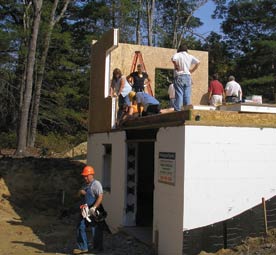
LEED Home with insulated concrete form foundation, Habitat for Humanity of Greater Plymouth,
Carver, Mass. Courtesy of U.S. Green Building Council
For a long time, green building was seen as a luxury. However, over the past 5 to 10 years affordable housing advocates have steadily figured out that a great majority of “green building” is in fact common sense that supports quality affordable housing: better windows, more insulation, construction materials that don’t make residents sick, improved ventilation, better lighting, and greater access to the surrounding community and transportation. Green and affordable pioneers have been steadily bringing these standards into all corners of the industry.
Evolution of Green Building
Green building originated out of energy conservation efforts of the 1970s. While many of those initial efforts fell to the wayside once energy costs became cheaper and more stable, cities such as Austin, Texas, and Boulder, Colo., continued to focus on ways to increase the energy efficiency of the homes and buildings in their community. In 1985, Austin adopted its first energy code and began rating single-family homes on their energy performance; within five years, the program had expanded to include water conservation, efficient materials use, and solid waste handling.
Austin Energy Green Building is now celebrating 20 years in the market. Since its inception, it has certified 10,000 green homes, saved over 53.6 million kilowatt hours of electricity and 65.8 million gallons of water, and diverted 120,698 tons of construction waste from local landfills.
Boulder launched its GreenPoints Program in 1994 and in 1996 became the first municipality in the country to mandate green building codes for residential construction. These programs are the pioneers of today’s green building movement.
Throughout the 1990s, other energy efficiency and green building efforts emerged. At the federal level, the Environmental Protection Agency launched the Energy Star label for homes in 1995. Energy Star focuses on energy improvements in several key areas: high-performance windows, tight construction and ducts, and efficient cooling and heating systems, and involves third-party verification. In 1999, Southface Energy and the Greater Atlanta Home Building Association launched the EarthCraft House Program. EarthCraft is now offered throughout the southeast and a good portion of the mid-Atlantic region (see p. 36). Green building programs also began popping up in Wisconsin, California, Washington, and numerous other states throughout the 1990s and early 2000s.
While none of these sets of standards specifically targeted affordable housing, some affordable developers took note and started incorporating green building practices into their projects.
Coming Together
By the late 1990s/early 2000s, many organizations had started building bridges between the environmental and community development sectors, identifying their commonalities and shared goals, and beginning to work together. An early example of where the two trains met is Florida’s Housing Trust Fund, which would most likely have never been created had the environmental and housing groups not recognized shared goals (see A Meeting of Movements, Shelterforce Jan/Feb 1999). The number of such alliances is growing every day.
The first decade of this century also saw a major acceleration in green building writ large as it became better defined and best practices were packaged together in national certification programs. The Leadership in Energy and Environmental Design (LEED) rating system was developed by the U.S. Green Building Council (USGBC) and launched in 2000. Since its launch, the LEED rating system has expanded to include a variety of sets of standards for categories such as schools (LEED-SCH), residential (LEED for Homes), and neighborhood development (LEED-ND). While none of the LEED programs speak specifically to affordable housing, its energy efficiency and health benefits quickly resonated with many in the affordable housing field.
Enterprise Community Partners, one of the leading providers of affordable housing development capital, launched its Green Communities initiative in 2004. Working with partners such as the Natural Resources Defense Council, Southface, and the National Center for Healthy Housing, as well as experts from USGBC, Enterprise developed its Green Communities Criteria specifically to meet the needs and goals of affordable housing developers. Enterprise also provided much needed training and financing through grants, loans and tax-credit equity to ensure that affordable housing developers had the tools they needed to incorporate green building standards into their projects.
Other national community development intermediaries also began to promote green building in affordable housing design and construction. LISC has actively promoted green building among its community development and affordable housing partners since 2004 through education, supportive grants and technical assistance. In 2008 LISC unveiled its Green Development Center to provide community development practitioners greater access to sustainable building and management principles.
In 2008, NeighborWorks America launched its Green Agenda program, which encourages its members to undertake green building and rehabilitation projects with incentives and funding opportunities. Although NeighborWorks had integrated green building and energy efficient techniques and practices into its National Training Institute (NTI) construction and operations courses for many years, adoption of the Green Agenda formally incorporated green building into practically every course, regardless of whether or not it is identified as a “green” training course. NTI now also offers a “Green and Sustainability” professional certificate program in its Construction and Production Management track.
The Premium Cost Myth
One of the biggest obstacles to bringing green building into affordable housing is the idea that it costs too much. Luckily, evidence is piling up to show this isn’t the case.
In 2003, the California Sustainable Building Task Force released a seminal study on the costs and benefits of green building that found upfront cost premiums ranging from 0 to 9 percent with long-term financial returns far outweighing those initial costs. Payback periods for most green features were as little as three years, while the long-term return on investment from lower utility costs and worker productivity continued for the life of the building, which was estimated at a conservative 20 years.
In 2005, New Ecology, an organization that promotes “solutions that deliver positive economic, environmental, and social returns,” or the “triple bottom line,” partnered with the Green CDC Initiative organized by LISC and the Massachusetts Association of Community Development Corporations to determine costs specifically associated with green affordable housing. Their study found an average upfront premium cost of less than 2.5 percent, which, similar to the California study, was significantly offset by long-term operations and maintenance savings.
Since these early reports, numerous studies have been done to evaluate the costs associated with green building. Most early adopters found that, as the learning curve goes down, so do upfront premiums. While high upfront costs are a major obstacle in developing affordable housing, it is the ongoing operating and maintenance costs that will make or break an affordable property over the long run. Building sustainably involves healthy, durable, energy efficient standards that minimize ongoing operating and maintenance costs and ensure buildings are constructed for long-term affordability.
Yet, there is a lingering perspective that green building is too expensive for affordable housing.
In the not-so-distant past, there was a similar perception about indoor plumbing. As public health officials made the link between housing conditions and health, they pushed for building codes that called for not only safe and sound construction, but regulations to improve sanitary conditions, i.e., indoor plumbing. The onset of indoor plumbing was met with resistance by many who claimed that its expense would be the death knell of affordable housing. While indoor plumbing definitely increased building costs, the health benefits it brought, including the elimination of cholera and typhoid, far outweighed those costs.
Where Green Is Now
Great strides have been made in green building over the past 10 years. Today, more than 50 percent of the housing certified under the LEED for Homes program are affordable. LEED and Green Communities criteria have been updated to reflect innovations and higher performance standards that have evolved as green building practices become more common. LEED for Homes has been expanded to include mid-rise multifamily buildings and LEED Neighborhood Development has become a standard for many public housing redevelopment projects. Enterprise released new its next generation Green Communities Criteria with a $4 billion commitment to affordable green housing over the next five years.
These economic times require us to look for the best return on our investment and elected officials know that green building provides that. In 2007, 92 communities with populations over 50,000 had instituted green building programs; by 2009, the number had grown to 138 communities. In 2008, the green building market was valued at approximately $42 billion; by 2010 it had grown to $71 billion and represented 25 percent of all construction; by 2015 it is estimated it will nearly double to $135 billion.
State legislature and regulatory authorities recognize that green building programs have the capacity to move the market toward healthier building practices. Over the past few years, they have adopted a multitude of policies ranging from energy efficiency standards to financing tools and investments in high performance building to incentives for green homes. Green building is expected from developers interested in using public funding: to date, 442 local jurisdictions, 35 state governments, and 14 federal agencies or departments employ a green building standard. In many jurisdictions, Enterprise Green Communities has become the building standard for affordable housing, especially housing built with public monies, because local officials understand the financial stewardship that green building offers.
Based on the report that Habitat for Humanity can now build LEED and Energy Star certified homes for as low as $100,000, SustainableBusiness.com identified affordable green housing as the number one trend for 2011.
“We have yet to hear from any developers that have completed a green development and then decided to return to conventional development practices,” says Dana Bourland, vice president of green initiatives for Enterprise Community Partners.
Codifying Green Building
One of the next steps will be codes. Since 1994, the International Code Council (ICC) has been charged with developing a set of comprehensive and coordinated building and fire safety codes. Residential codes developed by ICC and adopted by local jurisdictions govern how homes are built and, while some employ additional code standards such as the International Energy Conservation Code (IECC), most generally focus on standards related to structural soundness, fire protection, and sanitary conditions.
However, as green building standards have become more visible, an expanded view of building-related risks has been exposed. Green building examines the effect of long-term, cumulative exposure to toxins and hazards frequently found in our buildings and surrounding community. The emerging view from green building recognizes that codes should also address the toxicity of construction materials and reflect a commitment to practices that promote healthy living, preservation and protection of the environment, and conservation of limited natural resources.
While green building standards found in LEED, EarthCraft and Green Communities offer the guidance and leadership to build beyond minimum code requirements, backing these standards up with stronger, comprehensive green building codes is key to raising the bar on sustainable community planning. The ICC has taken the first step in codifying green building codes by developing the International Green Construction Code (IGCC). But for it to have an effect, local jurisdictions must adopt the code. Many local jurisdictions have adopted green building rules for public construction and several, including Boston, Washington, and San Francisco extend the rules to private construction, but they are still playing catch up with their codes. As of 2011, California is the first state to implement a statewide green building code.
What’s Next?
In light of the stagnant housing market, green retrofits are getting increased attention. As money for new construction dries up, the importance of preserving and retrofitting existing affordable housing stock to energy efficient, green building standards is of paramount importance. Greening the existing stock of affordable housing — both single and multifamily — will stabilize and reduce operating costs and preserve much needed affordability. It also serves as a greener alternative to new construction because it is rehabilitating properties where existing infrastructure already exists.
Affordable housing developers that have become old pros at green building are looking to employ deeper green building practices and experimenting with more innovative, higher-performance practices such as net zero (houses that generate at least as much energy as they use) and the Passive House standards (certifying houses for use of passive solar energy — which means it is not converted to electricity first — to reduce their energy needs).
Aeon, a nonprofit developer in the Twin Cities, is pushing the sustainability envelope in the final stage of its 10-year Gateway Project. Gateway has incorporated green from the outset, but in its final phase will push the envelope further by aiming to meet the Living Building Challenge created by the International Living Future Institute, described as “the most advanced measure of sustainability in the built environment possible today,” whose goal is to have “every single act of design and construction make the world a better place.”
Habitat for Humanity and the D.C. Housing Department will use the Empowerhouse, a prefab green home designed by a student team from The New School, Parsons, the Milano School of International Affairs, and the Stevens Institute of Technology, as their prototype for affordable, green housing in Washington, D.C. Designed to consume 90 percent less energy than a typical home, the solar-powered, passive-solar house will be moved to the low-income Deanwood community once it has finished competing in the 2011 Solar Decathlon.
In an economy where, according to the Joint Center for Housing Studies at Harvard, more than 10 million households (one in four renters) spend more than half of their income on rent and utilities, there are some critics who say now is not the time to focus on green building but to just provide a roof and four walls. But similar well-intentioned goals got us to the tenements of the last century.
Today, affordability is firmly connected to utility and healthcare costs. Any incremental effort that can increase energy efficiency and healthy environments must be done to expand the affordability of housing for low-income households. Moreover, we have to build in a more sustainable fashion so that we are not rebuilding the same affordable housing in 10 or 15 years. We need to stop for a moment, take a breath and realize what our ultimate goal is: strong, sustainable buildings and communities.
About the Author

Thanks for this fine summation of where we have been and where we are going with the greening of affordable housing. In writing the first draft of the DC Green Building Act in 2004-05, I researched some of the organizations, codes and policies. This was a great review and catch up on where things have gone since then.
I may have missed it in the article, but I do think that the Hope VI communities—especially High Point in Seattle and New Columbia in Portland were great precursors to LEED ND—with their numerous green and community-building elements. The Congress for the New Urbanism and its members ought to get some of the credit for that.