


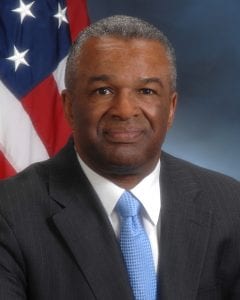
HUD Deputy Secretary Ron Sims
Shelterforce caught up with HUD Deputy Secretary Ron Sims on the precipice of retirement, nearly two-and-a-half years after joining the agency. Sims brought to HUD not only his political savvy, but also an unshakable commitment to equity and sustainability. In this exit interview, we talk about his accomplishments at HUD, plans for the future, and what he thinks needs to be done in order to stabilize the housing market.
Shelterforce: Tell us about why you’ve decided to leave HUD?
Deputy Secretary Ron Sims: It was time for me to go home, and although HUD is an amazing place, doing incredible work, and I’m working with talented people—I mean, they rock here—I began to daydream about being at home. I realized that that’s where my heart was. I’ve been here for two years and I have no family here—they’re all back in Seattle.
What are some of the lessons you’ve learned from this stint at the federal level?
Ron Sims: Several things. There are gradations of flexibility and speed. Obviously, I’m still a local person and so I think local government moves very quickly and that there are expectations that the federal government cannot, but I think that it is important that the federal government understand that every community is unique and that we learn to listen.
I always say: “There is no one-size-fits-all.” What you have to do is establish goals and then let people tell you how they’re going to achieve those goals and do that not just with your money, but what are they doing to leverage other funds: philanthropic community funds, business community funds, local government funds, faith-based community funds, so that we’re bringing what I call the wealth of a community to bear on the things that we want to do. The sustainability grants are written that way and I think they broke the ice not only because we had the grants but because so many people applied for them because of their willingness to move in that direction. It’s taking the accumulated wealth of a region and applying it to their issues with the federal government being a partner and a stimulus. So I feel really good about that.
But I’ll miss the employees we have here who believe in what they do. I believe that you are only as good as your employees are and you only as bad as you allow yourself to be, and that if you empower your employees, we can achieve anything. Employees here are empowered and there’s enthusiasm for tackling all of the problems facing our communities and a desire to get things done differently.
Have you fulfilled your goals?
Ron Sims: Obviously, there are things left to do — there are always things left to do. But, for years the word “HUD” was never said with affirmation. There was a young lady in the Baltimore office who said “When people ask me where I work, I used to say ‘the government.’ Now, when people ask me where I work, I say “the Department of Housing and Urban Development.” She was so proud to be able to say that, and I think it’s really important that we instill belief in people, as well as attract a lot of talented people here.
If you look at HUD’s fundamental statute, we were supposed to be the group that helped end poverty. We were supposed to be the group that made sure that people had a chance to buy a home whether it was through FHA or multi-family homes. We’re the ones charged with ending homelessness and now I think now people are beginning to see the agency’s depth and breath. It was amazing being part of that and being around amazing talent in the field offices, regional offices and headquarters that could make that happen. And of course, in the end, it is whether or not we are able to prove ourselves to stakeholders.
What do you consider your greatest accomplishment at HUD?
Ron Sims: I’m an old school person. I believe in the totality in a team not the stars on it. I believe what I was able to do here at HUD is articulate the need to get out of silos, to tackle a problem, and not to fix blame if something went wrong. If you take risk and succeed you deserve applause, you deserve praise. If you take a risk and you fail, you deserve applause. It’s the failure to do anything that should be a bad day for you.
Secretary Donovan set out to create a new DNA for HUD. That’s how he described it. That is, risk taking, moving more responsibility to the local level, and setting goals that were once deemed impossible. All of a sudden you say, “Impossible or not, I’m going to do it.” Policy aside, changing the culture here is a great accomplishment.
And in doing that, what were some of the challenges and how were you able to overcome them?
Ron Sims: We have 80 field offices, but there’s always been this idea that things should be run out of headquarters. This is where empowering the field offices needs to happen. On the local level, you need speed. No matter who is president and who controls Congress, what you want is the ability for people to make quick decisions and I don’t think federal government does that very well. Another thing I’ve tried to do is to instill the idea that it’s OK to make a decision. Another lesson I’ve tried to teach is that process should never eclipse product. What good is the process if it gets money out late, ties up money, requires a gazillion reports before anything is spent, and says you can make no mistakes? This is the stuff that makes people timid, and it’s not what we should do. In my time here, people have discarded those things and realized that speed and risk taking were incredibly important and meaningful. Over time we saw the Recovery funds accounted for and sent out the door faster. I had less fraud than the other departments, and part of that was getting out of the way of the people doing the work. They take pride in their work, they work really hard, and they love the mission.
So, I don’t want to point out specific challenges to this program or that program because I was lucky. I got, at times, to be the coach to call the plays, but somebody made a great catch. And it succeeded. I encouraged smart people and people who believed in public service to do what they do best.
You’re expected to speak at the National Community Land Trust Network meeting this fall. What’s your evolving view of what sort of role that the shared-equity form of tenure can play as we move towards stabilizing the housing markets and figuring out how they are going to work going forward?
Ron Sims: One of the things I worry about in the long run is the accessibility of housing and who gets into housing. Buying a house has always been the American dream, and you know now we’re having a debate whether or not people should be satisfied being a renter all our life. And I say you can’t do that because when you look at the numbers it breaks up very plainly along racial lines. So innovations coming out of the land trust model that will allow people the security and ability to get housing will be absolutely key for long term social stability. We’re not just talking about a notion here. We’re talking factually about what we know and the data that we now have, right now. If they fail we’ll have social instability. If they succeed we’ll have social stability. In the most competitive century in our history, we cannot afford to have social disruption because we are unable to have people in stabilized neighborhoods and housing.
There’s a great book, The Warmth of Other Suns by Isabel Wilkerson. In that book, she talks about the housing riots of the 1900s, 1910s, 1920s, 1930s, and 1940s, and they were fiery and violent. I didn’t realize that. And they eclipsed what happened in the 1960s but it was all over housing and housing location: people being confined to rental and not being given the chance to buy. And people wishing to buy who were not allowed to do that. We face similar challenges today, that is who’s foreclosed on and who needs to get back in this market.
So if, in fact, we restrict people from buying homes who cannot put 10 percent down and 20 percent down, we need to have a counterbalance that enables people to get into homes. Now, there are great organizations that are fighting to get housing near jobs, improve transportation systems, and providing access to homeownership. They need to succeed, because if they do, we can avoid what I call the train wreck. If they fail we are going to have a very significant social upheaval. We will: it’s unavoidable.
A lot of people don’t necessarily believe that you’re retiring completely from the public sphere. And obviously you’re passionate about Seattle and King County. What can we expect from you in the weeks, months, and years ahead?
Ron Sims: Oh, I would never move out of the public policy sphere. I love it too much, but I am retiring from HUD. Just yesterday, the member of my Washington delegation called and said “leaving public service is not even a negotiable item with us,” and I agreed. I don’t know what’s next, what forms it’s going to take, but I’m not going to retreat, I’m not going to retire from life and I’m not going to retire from what I love, but I am going to retire from HUD.
Thank you.
For more reading, see Shelterforce’s winter 2010 interview with Deputy Secretary Ron Sims.

Comments