

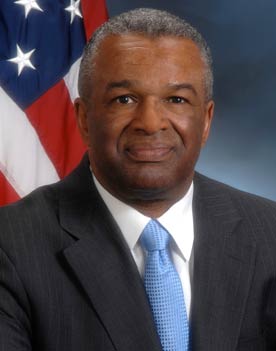
HUD Deputy Secretary Ron Sims
HUD Deputy Secretary Ron Sims’s unorthodox approach, particularly in a government agency with $44 billion in discretionary budget authority in FY 2010, stems from his time as a three-term county executive for King County in Washington state, the 13th largest county in the country, where he attracted national attention for his work on urban development, affordable housing, transportation, and homelessness, as well as funded nearly 6,000 housing units. Sims brings a new philosophical orientation to HUD that emphasizes both public and private equity, innovation, and long-term sustainability.
Shelterforce: As King County executive in Washington State, you were heavily involved in policy and politics at a regional and local level. How does your time there inform work at HUD?
Ron Sims: King County’s a very complex environment. There are 38 cities and we had jurisdiction in cities and out and we had responsibility for how the area would grow. We chose very, very early that we were going to have a sustainable vision, and that would entail trying to increase the densities in the cities.
I used to tell people to “take a risk.” I would sing your praises if you succeed. If you fail and you tried to do something new, I’ll protect you. But if you were inert or cautious, I would try to make it a very challenging day for you. We called ourselves a living lab. So at HUD, I find it’s important to let talent do what talent does best, which is explore new ideas.
And from the policy side, there has to be a standard of livability. What we found was that the high-water mark for African-American homeownership in our region came in 1970, at 50 percent homeownership, with 48 percent having two parents in the household. By 2006, it was 32 percent homeownership and 28 percent two parents in the household. We were seeing similar declines in Latino populations or subgroups of Asians. And urban Native Americans never had a high-water mark.
We could predict life outcomes by zip code. We could say, if you’re in one zip code, you’re likely to have diabetes, you’re going to die of heart disease, and oh, by the way, you will likely get amputations as a method of treatment where another community would get pharmaceutical treatment. We could predict rates of childrens’ tooth decay. In King County in certain zip codes, [of the kids] on subsidized lunch, 28 percent of second graders would have eight active decaying teeth, so they were learning in pain. A zip code should not determine a person’s path in life. Sustainability had to lift all boats or it was a failed exercise in policy.
So we came out with an equity tool [that] we would embed into our comprehensive plans, with the idea that every community would change.
So when I met Secretary Shaun Donovan, I was going over the issue of equity tools, densities, integration of transportation — things that he was already thinking about and in fact, was assembling a team of people who believe in sustainability, who had the talent and skills to enable this. So in going to HUD, I saw the possibility of King County on a broader scale.
And how are you starting to see that philosophy and that culture change play out throughout the agency?
Everyone accepts sustainability, which is great. I don’t have to argue anymore about health consequences. U.S. Department of Agriculture has a sustainability group that’s now meeting with our sustainability group every single week. The U.S. DOT sustainability group meets every single week with our group and the EPA, all in the same room, all at the same time, working on sustainability issues. The Centers for Disease Control and Prevention is now coordinating with us on the issue of health impacts in the built environment. Veterans Affairs and Health and Human Services and HUD are working jointly on a process of how to end homelessness. Those interagency programmatic silos are dissolving very, very quickly. So we feel the cultural change.
We’re also working toward increasing the delegation of responsibility to our field and regional offices so that they can mirror what’s happening in Washington, D.C. Once that happens, they can be more aggressive than ever before. So the change is occurring.
You’ve said that sustainability is not the exclusive domain of the rich and that long-term sustainability policy should benefit low- and moderate-income individuals. But things like transportation require long-term commitment and investment. How do we turn this into policy when people are looking at short-term economic forecasts rather than the long-term economic benefits?
I’ve always thought it was going to be a marathon, not a sprint, because you’re talking about literally a sea change in how we look at cities and growth.
I always point out to people the problems of having too short-term a vision. When a person says to me, “I’m conservative,” I say, “Are you conservative for the moment because you think it’s great politics, or are you actually really a fiscal conservative?” A real fiscal conservative will look at sustainability and realize it is going to be cheaper in the long run, and particularly to the generations that are going to be adults in the most competitive world ever, and they’ve got to be able to use their money for things like education and technology and not have to spend money encouraging more sprawl or discouraging effective public transportation systems that move people efficiently.
Our competitors are investing in that even in these hard times. There’s got to be a long-term policy. When people say: “I want to be fiscally prudent,” they often shoot themselves in the foot. Fiscal prudence doesn’t necessarily buy prevention, and our key is to be far more preventive against excess cost and poor planning and being indifferent to the weight of their costs for future generations.
I would rather have my granddaughter and future generations tell me that she was proud of what we did: investments in good housing, public transportation, parks, and schools. Those generations will know that they can compete.
In the paper a conservative said sustainability is socialism. I say, “Give me a break,” because the ultimate savings of long-term resources helps future generations compete. So I get past the rhetoric, but it concerns me when I see it. I keep thinking we just have to endure, that people will have to realize the economic return of using resources and money smarter than we’ve ever used it before.
There’s a rhetorical barrier that you’ve just spoken about how to overcome, but what about the political barrier? “Long-term” is often two or four years.
Yes, unfortunately. But remember, 52 percent of [the requests for sustainability grants] were from small cities in rural areas. We have tapped in, I think, to a lot of people at the local level, the mayors and city councils, the businesspeople, the neighborhood people who are all saying there’s got to be a new day, because it’s the smart thing to do.
And how do you institutionalize this approach?
My wife used to tell me when I was in King County, “Remember, there are people that will be there now and are going to be there after you leave.” Political appointees are called short-timers because we’re only going to be there four years or eight years. Other people have been there 35 or 40 years.
But when you empower the people who have been there for a long time, they find is that this is exciting. That’s why they came to HUD. When you tell them what the change is going to be, then, all of a sudden, those people become believers.
Can you tell us some specific examples from your travels around the rest of the country of exciting, new approaches that HUD should be looking to to emulate?
There’s a good example from Cleveland related to Section 3 requirements — when you have HUD money, that’s supposed to create jobs. While I was there, a person was telling me about the Evergreen Cooperative Initiative [launched in 2007 by a working group convened by the Cleveland Foundation. She was telling me about the excellent hospitals in Cleveland, that all suffered from a laundry issue. All of them knew they needed new laundry capacity, but none of them wanted to build a laundry on their own.
So the Cleveland Foundation says, “Why don’t we create a co-op that will do your laundry? And the people who are going to work in that co-op and be the equity holders of that co-op will be people who’ve had erratic employment histories, that are poor, that might have been in and out of jail. They will be the people that we will train to work in that laundry, and then it’ll be really well managed on top.”
So I said to the people in HUD, “Have we ever thought about telling [residents of poor communities], ‘Why don’t we make you the employer?’” Isn’t that what we really want to achieve in the end: self-sustaining employment, to have them take a risk so they are the ones knowing they have to go to work because, in the end, it is their company?
Now that’s what they did in Cleveland at the Evergreen Co-op. They’ve applied it now to solar, and they’re now doing a plan so that they will grow crops in the winter in these large greenhouses and sell them, but again, all the participants will be people out of these poorer communities. Brilliant.
So we are now changing what we call Section 3. We have a team that we’ve sent out in the country to look at innovative practices, and then we’re going to create training sessions. All because I was out in Cleveland.
The best program, bar none, in the United States for ending homelessness is in San Antonio, Texas, the Haven for Hope project.
Then there’s Mud Island in Memphis. They consider themselves the first urbanists. Mud Island still has a beauty that our HOPE VI projects don’t. I’ve been trying to get to the people in HOPE VI and saying, “Look at Mud Island in Memphis. Look at it. It’s really done well.”
What do you think of shared equity homeownership and community land trust models’ role in the sustainability picture?
I think you have to do that. In King County, we had a lot of county property that was available, and we went with just that concept. The idea was that you would always keep that housing stock affordable, and that people coming into it, if they sold it, would realize that it would not be sold at market rate. They bought it as affordable housing, and when they sold it, it would be affordable.
There’s an interesting commercial CLT starting in the Central City retail corridor in New Orleans that’s trying to get off the ground now.
And I think HUD’s job is to stimulate those things. One of the things that surprised me at HUD was that you had the demolition of public and Indian housing buildings but that they were not being replaced by affordable housing. I remember going down into a meeting once and saying, “How can that happen?” Everybody was explaining the rules, that there’s a different rule governing the disposition of surplus property, and I was going, “But you’ve basically once financed it as affordable, but it’s not being replaced, so we will never be at the front of the affordable housing issue. We’ll always be behind it.”
It was really interesting, and it resulted in the attorneys in HUD reminding people that you can dispose of this property and still mandate one-for-one replacement and how that should look, or you can look at mixed development, and so they’re doing that more often now.
There was a lot of internal resistance to those changes, though. I mean, people said, “Why change?” and [I said] because we need to maintain affordable housing stock and add to it; we don’t need to subtract from it again, because we’ll never catch up to the demand, and we’re still a long way from meeting demand.
There’s also a real fear of giving communities too much control.
Remember, I’m a local guy. But then there are areas where the locals hate — they literally hate — any idea of having anybody with Section 8 living within 100 miles of them. That’s a different kind of community, and there you do want to be able to say “You don’t have a choice.” This country is great because it’s always provided choice and opportunity, and we should be committed to that. Locals are not always perfect.
A large number of funding programs through HUD have very limited affordability that spans 20 or 30 years. Many are being lost now as the restrictions expire. Are there ways to move beyond temporary affordability?
HUD cannot be the barrier to the preservation of a long-term affordable housing stock. That’s what HUD’s charge is: providing housing opportunities.
I don’t think any of us wants to be the generation that watches the loss of our superpower status in the world. That’s why I think we see President Obama and Shaun Donovan giving people like me a lot of leeway, because I think we’re very clear about what these investments will do in the long run for America’s competitiveness.
Thank you.
About the Author


Comments