

David Schalliol
If there’s any bright side to this protracted housing crisis, it’s that dramatic declines in home values have greatly improved affordability for first-time homebuyers. From early 2006 to early 2009, the U.S. median home price dropped from $227,100 to $166,100. Combined with lower interest rates, that means that monthly payments for a newly purchased home at the U.S. median price with a 90 percent mortgage declined from $1,300 per month to just $800. By 2010, mortgage payments on a median-priced home (assuming a 10 percent down payment) were less than 20 percent of the U.S. median household income for the first time since records began in 1971. Mortgage payment to income ratios in over 80 percent of the nation’s metropolitan areas are even significantly below averages from the 1990s, well before the housing boom.
But many households are, at best, not in a position to benefit from lower prices. The recent crisis has underscored the fact that the ability to purchase a home does not guarantee the ability to live affordably.
Foreclosure Impact
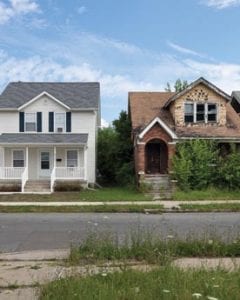
Those who already owned their homes have certainly not been helped by the wave of foreclosures and the price declines, but the effects have been worst in low-income and minority neighborhoods.
According to the Mortgage Bankers Association, since the first sign of a spike in defaults in early 2007 through the first quarter of 2010, there have been over 6.1 million foreclosure notices issued to homeowners around the country. Delinquencies and foreclosures have been highly concentrated in a small number of states and even more concentrated at a neighborhood level. According to our analysis of First American CoreLogic data, of loans originated in 2006, over two-thirds of all delinquencies occurred in just 25 percent of zip codes, while the top 1 percent of zip codes held over 10 percent of delinquent loans.
Low-income neighborhoods have seen the highest delinquency rates, minority neighborhoods of all income levels have significantly higher delinquency rates than mixed or white neighborhoods, and low-income minority neighborhoods have had the worst delinquency rates of any—at fully 27.5 percent of all loans. Contributing to these high delinquency rates is the fact that low-income minority neighborhoods saw much higher levels of high-cost, subprime lending. According to HUD, half of the loans in a median low-income minority census tract were high-cost loans, while the median share of high-cost lending in low-income white tracts was one-third.
Even for those who have not yet faced foreclosure, drastic price declines have signaled a dramatic destruction of wealth, especially for low-income homeowners, for whom their home is usually their largest asset. In almost all metropolitan areas covered by the S&P Case-Shiller Tiered House Price Index, average price declines for low-end homes through the downturn were more than 50 percent greater than declines among high-end homes.
According to First American CoreLogic, by the first quarter of 2010 over 11 million homeowners were “underwater” — owing more on their mortgages than their homes were worth. Given that they also entered the downturn with the least equity in their homes, low-income and minority homeowners were likely to be overrepresented in this group. Underwater homeowners are in the tenuous position of not being able to refinance or sell without providing additional money to their lenders, which increases their risk of foreclosure given any loss of income or increase in adjustable rate mortgage payments.
The Erosion of Affordability Persists
The last decade continues a striking 50-year erosion of housing affordability in the United States. In 1960, only 12 percent of renters spent half or more of their incomes on housing costs; by 1990 that number reached nearly 20 percent, and by 2008 it had exceeded 24 percent.
This increase can be attributed at least in part to long-term structural changes in the labor markets. Recent studies by the National Bureau of Economic Research find a polarization of the U.S. labor markets in the past decades that has hollowed out the middle class and increased the number of low-wage workers who are most likely to face housing affordability challenges. The demand for both high- and low-wage jobs at the expense of middle-income moderate-skill jobs accelerated in the 1990s.

In sharp contrast to the trend over the prior 30 years, in the 2000s household income at all age groups and income quartiles declined. Hardest hit have been young, low-income householders, whose incomes, after adjusting for inflation, have dropped more than 16 percent from 2000 and 2008, a period that does not even include the heavy employment losses experienced in 2009.
During the first half of the 2000s, incomes failed to keep up with skyrocketing house prices, rents, and utility costs. Since the housing downturn began, however, any decreases in housing costs have been outweighed by the even greater decline in household incomes. As of the most recent data in 2008, over 40 million households have at least a moderate housing cost burden, spending more than 30 percent of their pre-tax income on housing, while 18.6 million households pay over 50 percent of their incomes, an increase of nearly 4.8 million households just since 2001.
Housing cost burdens are especially common for low-income residents. Approximately three quarters of all households with severe housing cost burdens are in the bottom income quartile, where one out of every two households is cost burdened. Low-wage work simply does not cover housing costs. Indeed, there is no county in the nation where full time work at the federal minimum wage enables a single earner to afford a modest apartment at the HUD-designated fair market rent for that area for less than 30 percent of their income.
More than 40 percent of households with one to two workers earning the full-time minimum wage face severe cost burdens, but this drops significantly — to 25 percent for owners and 10 percent for renters — for households earning two to three times the full-time minimum wage. Given the prevalence of low-wage work, many low-income households typically rely on multiple earners to afford their housing.
With the economy shedding 8.4 million jobs since 2007, household incomes are under extreme stress. The number of multiple-earner households has declined by over 2.7 million from 2007 to 2009, and the number of households without even a single earner increased by 2.2 million.
Supply Dwindling
While low-income households struggle to afford and maintain their housing, the housing stock available to them is shrinking. According to a recent Joint Center for Housing Studies analysis of data from the 1997 and 2007 American Housing Surveys, more than 800,000 units of low-cost rentals (renting for under $400 per month) occupied in 1997 were permanently lost from the housing stock 10 years later. Thousands of other units were upgraded to higher rents or switched tenure to become owner units.
The credit crisis also severely cut into the ability to preserve and replace these units. The nation’s primary mechanism for building and preserving affordable rental housing, the Low Income Housing Tax Credit program, which is responsible for financing approximately 100,000 units per year, has suffered a severe drop in investor demand. The disruption has so far stalled thousands of projects. State housing finance agencies (HFAs) have faced a liquidity crunch and had difficulty finding investors for their new-issue bonds, used to fund affordable rental housing production. Two stopgap programs were introduced in 2009 to provide gap financing and offset the decline in tax credit financing for LIHTC projects, while the U.S. Treasury stepped in to help provide liquidity to HFA rental programs, but while investor interest has improved in 2010, new construction is still limited.
Foreclosures and the restriction of credit to landlords may also be leading to deferred maintenance that may lower the quality and accelerate future losses of the rental stock. This is especially the case for small-property resident landlords, who own a significant share of the low-cost rental units and who are often low-income households themselves, with limited means to maintain, let alone improve their properties. At last measure, approximately 40 percent of all resident owners in two- to four-unit rental properties had incomes below $30,000 per year. Without access to credit, it is feared that many owners may not be able to fund improvements or repairs to low-rent housing stock, given the low levels of rental income these units provide. Such conditions may also be a barrier to the turnover of these units to new and more financially stable owners.
Foreclosures, tighter lending standards, and a growing number of young echo-boomers have increased demand for affordable rentals. After several years of decline, the number of renter households surged by 3.4 million from 2004 to 2009. The fact that rental vacancy rates overall still managed to rise during this period masks the continued tightness within the low-end rental market. According to the U.S. Census Housing Vacancy Survey (HVS), the greatest increases in vacancies have been in large properties with 10 or more units, which tend to be largely institutionally-owned, higher-quality, higher-rent units.
Also clouding the picture is that many apartment rent indexes that have reported softening rents are surveys of these institutional owners and therefore most reflective of this higher-end market segment. In contrast, data on vacancies by rent level, according to JCHS tabulations of HVS data, show that from 2004 to 2009, while the number of vacant rental units renting for $1,000 or more increased by 76.5 percent, the number renting for under $600 dropped by 18 percent, or over 332,000 units.
Jobs Are Key to Recovery
History suggests that the sustainability and magnitude of the recovery in housing will depend greatly on the status of employment growth. However, the employment situation is currently very dour. As of June 2010, unemployment reached 14.6 million workers, nearly half of whom, nearly 6.7 million, have been unemployed for six months or longer. Young and minority workers have clearly been hit hardest by unemployment during the recent downturn. In June, the unemployment rates for black (15.4 percent) and Hispanic (12.4 percent) workers were, respectively, nearly 80 percent and 44 percent higher than for whites (8.6 percent). Combining age and race, nearly one in four blacks aged 20 to 24 were unemployed in 2009, compared to one in six Hispanics and one in eight whites of similar age.
With labor markets so challenged, concern is growing over the ability of today’s young workers to get the jobs and experience needed to keep up with the earnings levels of prior generations. While the recession is severely hindering the ability of young workers to gain necessary work experience to advance their skills and improve their earnings potential, even before the current recession younger households (those headed by persons under age 55) were on a path to end the decade with lower real incomes than their predecessors.
Adding to the concern, even if immigration remains low, the echo-boom will still raise the number of household heads under age 30 to record levels by 2025. As the younger generations are also more racially and ethnically diverse, advancing them will necessitate such things as addressing gaps in educational attainment and college graduation rates. Unless rents, home prices, and other housing costs undergo adjustments similar to those seen in the incomes of younger generations, future households will need to reduce the size, location, and amenities of their housing or they will continue to face growing affordability challenges.
The past year exhibited signs of a comeback in many areas of the housing markets. But the softening by mid 2010 showed that housing markets are still fragile. Without a concurrent turnaround in jobs and the economy, housing markets will continue to be weak and face significant challenges. For low-income households, many of these challenges go beyond the current economic cycle and have been building for decades. Without additional assistance to balance the supply and demand for housing affordable to low-income families, affordability will continue to be the primary challenge of housing in the future.
About the Author



Comments