


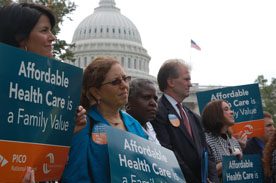
Photo by Tim Lilienthal
Community organizing faces a dilemma — and not just the recession. Its face-to-face communities put the “roots” in grassroots. Yet local organizing alone cannot address the national, even global sources of policies felt at the local level. Organizers are learning that to win locally, they have to fight nationally. ACORN has mounted national campaigns for years, with notable successes. This very success and visibility brought a bitter corollary, of course; its massive voter registration effort drew the wrath of conservative media and Republicans, suggesting that ACORN must have been doing something right (and, yes, a few things wrong). They weren’t alone. National People’s Action (NPA) led the early fights to win the Home Mortgage Disclosure Act (1975) and Community Reinvestment Act (1977), which then became essential linchpins of future campaigns by ACORN, NPA, and faith-based organizations as well.
But no faith-based organizing network attempted to become a national player — until recently. Though some mounted limited national efforts well before 2008, over the past two years faith-based organizing has finally “gone national.”
The Challenges
Faith-based community organizations (FBCOs) face particular and significant challenges in shifting scale to national campaigns. A typical local FBCO is a federation of 15 to 30 or more member congregations (and sometimes schools, unions, and other groups). Each is legally independent, but usually a member of a national network, federations such as the Industrial Areas Foundation (IAF), PICO National Network, Gamaliel Foundation, or Direct Action and Resource Training (DART) Center.
ACORN, by contrast, not only has neighborhood chapters, city affiliates, state organizations, and national offices — but, unlike the FBCO networks, it is one national organization with centralized authority located in the national staff and board. For years ACORN has also had specialized national staff in Washington, D.C., who work with Congress members and build alliances. While it can take months for each member church of an FBCO to agree on a citywide campaign or for a group of FBCOs to agree on a state-level campaign, centrally coordinated ACORN can turn on a dime.
Unlike ACORN, FBCOs are 501(c)3 nonprofit organizations made up of other 501(c)3 — congregations. They cannot run or endorse candidates for office, although they can run nonpartisan issue campaigns. But more serious barriers to their going national have been their localist bias, inadequate resources, and decentralized, highly democratic authority structure. FBCOs often feel torn between their strength — deep, member-led local capacity — and national ambitions. They also often lack the capacity (number of affiliates and money) to realize those ambitions. ACORN developed brilliant strategies for mobilizing resources through contracts to provide services such as homebuyer counseling, screening, training, and recruiting those eligible for the Earned Income Tax Credit. Most FBCOs have relied on traditional foundation and denominational sources of funding, internal fundraisers, and congregational dues. When ACORN’s budget was close to $40 million, the PICO Network’s combined budget was only $18 million.
However, FBCOs have leapt over these hurdles. PICO and the Gamaliel Foundation have brought top leaders from all over the country together and brought them to Washington for lobbying, planning, rallies, and press conferences. In PICO’s case they have built relationships among national leaders through repeated Washington gatherings since 2002, culminating in a national steering committee. All of them have formed unprecedented coalitions and learned tactics from advocacy and interest groups while retaining their unique source of power: a mass base.
About the Author


Comments