


 Across the country, community development corporations (CDCs) have responded aggressively and effectively to the challenges of the current economic crisis. But at the same time, funders, investors, scholars, policy makers and many practitioners are asking if the CDC model still works. Can CDCs help this country recover? Do we need a different organizational model or models to achieve our goals in the coming years? Such questions are scary and threatening to many of us, particularly at a time when CDCs (like everyone else) are struggling. But community developers and their supporters need to take this opportunity to seriously examine the challenges, to listen to the critics, to take a hard look in the mirror, and to articulate a vision and a strategy for the future, rather than reflexively defend our past models and practices. To remain effective, CDCs and their funders, investors and partners must be willing to change. If they are, CDCs will play a critical role in helping our country recover from today’s economic challenges so that all of our communities and residents participate in that recovery.
Ground Rules For Change
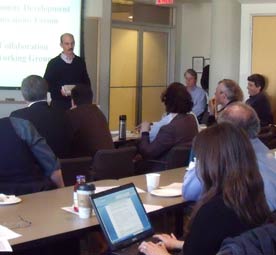
As we figure out what form this “change” will take, we need to engage in an ongoing dialogue — one that’s ostensibly already begun. Unfortunately, the conversation that examines the future of CDCs that has unfolded across the country so far has been plagued by confusing rhetoric, varying priorities, multiple agendas, unproductive turf battles, and a quest for a one-sized-fits-all solution for the entire country. We must get past these obstacles and have a thoughtful conversation about the future of the field. For the past two years, the Massachusetts Community Development Innovation Forum, a project jointly sponsored by MACDC and the Boston office of the Local Initiatives Support Corporation and supported by a broad cross section of people and organizations in the community development field, has launched a deep examination on the future of the field. From this experience, which continues to unfold, there are five critical ground rules that should guide any discussion: Identify shared values. Talk about the shared, core values rooted in social, racial, and economic justice committed to both community and individual empowerment. Be results-oriented. Performance is critical — and it must be measured and rewarded. “Performance” includes the production of homes, jobs, and businesses, but it should also include community leader development, the creation of healthy neighborhoods and linkages across sectors and programs, as well as the cultivation of strong community and civic life. Some of these outcomes are harder to measure, but they are no less important. Acknowledge the past. We’re preparing for change, and it’s essential to recognize and honor the achievements of CDCs and their partners over the past 40 years. In Massachusetts, for example, this is done annually with the publication of the Growing Opportunities Assets and Leaders (GOALs) that reports the success of MACDC members. While the CDC model needs to be revisited and constantly updated for changing times, it has been remarkably effective, durable, and flexible, working across diverse communities and economic climates. Be flexible: While we should not ignore lessons learned over the past 40 years, we also must not be trapped by old orthodoxies, ideologies, and habits that no longer make sense. CDCs, intermediaries, CDC associations, foundations, policy makers — all of us should be subject to review, critique and reform. Coming to “terms.” Perhaps the term that creates the most confusion is the one at the center of this conversation: “community development corporation.” After 16 years working for a CDC association, I like to joke that I still don’t know what a CDC is. But it is no joke. None of us really knows. The extraordinary diversity that exists among CDCs (and the communities they serve) makes it hard to craft a meaningful definition, making it challenging to appeal to funders and policy makers, to develop consistent metrics and standards, and so on. Discussions about the future of CDCs and the role that CDCs should play are therefore confusing. Are there too many of them or not enough? Are they too small to be effective or too big to be genuinely accountable and rooted in local neighborhoods? Are they too focused on bricks and mortar or not sufficiently capitalized and staffed to be effective real estate developers? Are they trying to do too many things at once or are they not comprehensive enough? The questions can go on and on and there are at least a few CDCs that can be highlighted to underscore any criticism or viewpoint. At best, the lack of shared understanding makes it hard to have a coherent discussion. At worst, this confusion could take the movement in the wrong direction.
Participants in the Massachusetts Community Development Innovation Forum vigorously debated whether it was helpful to establish a common definition of the term CDC and if so, what that definition should be. Compelling arguments were made that any definition would be both too broad and too narrow and it was not really important to distinguish CDCs from other nonprofits so long as the work was getting done. Others argued it was necessary to define the field in order to attract resources, credibility and to develop infrastructure, standards and metrics to enhance performance. The idea is that knowing which organizations qualify as a CDC will help strengthen the field in much the same way that the Federal CDFI program has led to a major expansion of CDFIs in this country. In the end, we agreed to file new legislation designed to update a 1977 statute that had created a standard definition of the term that was now largely ignored. The bill would create a more flexible definition that reflects the diversity of the field and would require the state to formally certify CDCs. Such a program could enhance the field’s credibility, attract resources, and expand impact. Our proposed definition addresses both who governs the organization and what the organization does. Specifically, to be a CDC, the bill states that:
The organization must be governed by the constituency it serves. This means that their board of directors must be representative of their community, in terms of geography, income and ethnicity. Further, the organization must be authentically rooted in the community and provide local residents with genuine decision making roles.A primary purpose of the organization must be to engage local residents and businesses to work together to undertake community development programs, projects and activities that develop and improve urban, rural and suburban communities in sustainable ways that create and expand economic opportunities for low and moderate income people.
So where do we go from here? How can policy makers, funders, and practitioners contribute to a strong, effective and durable community development movement for the 21st century? Here are eight ideas for what we need to do.
In creating sustainable change over time, a community development system, like natural ecosystems and economies, is a network that requires diversity, redundancy, competition, and a healthy environment. We need a wide variety of CDCs — urban, suburban, and rural; small, medium and large; neighborhood based and regional; those that provide housing and those that are multi-actors. Different roles and approaches — including some level of overlap, duplication and competition will ensure long-term sustainability and maximize impact. In such a system, the demise of a single entity is unlikely to disrupt the entire system and new organizations can bring innovation and change. By contrast, as the current banking crisis demonstrates, a system that depends on a small number of very large institutions can be brittle and subject to rapid and dramatic breakdown. Of course, healthy, natural economic systems require a regular cycle of birth, growth, and death. Some existing organizations have outlived their usefulness and others have struggled for years to achieve meaningful impact. They need to be willing to recognize when it is time to close, or merge, or move their programs to another agency. At the same time, healthy systems also welcome new life on a regular basis. The notion that we have “too many CDCs” creates a danger that will stifle new leadership and creative organizations that have yet to be born or even conceived. A recent study by the Aspen Institute found that nearly one half of the young leaders who aspire to lead nonprofit organizations hope to start their own organization. Our movement needs these young leaders and we must create space for them in our field. Funders and policy makers must adopt policies that allow new organizations to start, and they must also impose the discipline necessary to let others close.
Think long term
Our desire for measurable results each quarter cannot create such short sightedness that we fail to invest in long-term efforts that can create transformative change. The most successful CDCs in Massachusetts and around the country are the ones that have been able to sustain their efforts over one or more generations.
Make the business of community development financially viable
A well-managed, disciplined CDC can execute its programs and projects effectively. At the same time, the “profitability” of most CDC activities is determined not by pure market forces or even their own actions, but by the policies adopted by government agencies and to some degree private funders. CDCs that undertake affordable housing development or operate community programs should be able to earn enough money to both cover their costs and build their financial capacity over time. One key recommendation emerging from the Innovation Forum is that affordable housing policies need to be adjusted to better ensure that nonprofit developers can earn ongoing revenue from their existing portfolio of properties. Such revenue not only rewards sound management practices, but it strengthens organizational capacity over time and reduces reliance on developer fees that, at best, are an uneven source of revenue. Too often, funders seek to squeeze their CDC partners in the name of fiscal responsibility in ways that undermine our long-term efficacy. Policy makers should reexamine allowable developer fees, cash flow distribution, overhead rates, and other policies that impact CDC fiscal viability. Funders should see such payments as investments in future capacity and long-term sustainable community change.
Create a consistent source of working capital to support effective CDCs.
There is clear evidence that access to stable and flexible funding helps to increase long-term CDC impact. This has been demonstrated in Massachusetts where for over 20 years the state provided funding to CDCs, helping to create one of the strongest CDC networks in the country. LISC, Enterprise, and NeighborWorks have all repeatedly demonstrated the power and impact that such funding can have. As part of our nation’s long-term economic recovery strategy, Congress should establish such a program. Congressman John Lewis is expected to file such legislation later this year to do just that. In the short term, public and private funders should provide an immediate infusion of capital to sustain the field during this crisis as Congress has done for other nonprofit sectors such as Community Action Agencies, Community Health Centers and Community Development Financial Institutions.
Update and Modernize our Community Development Infrastructure
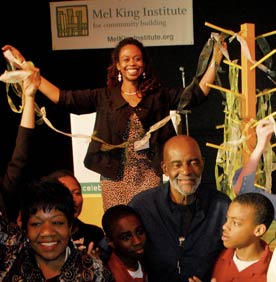
Effectively designed support systems can enable CDCs to remain relatively small, efficient, and locally accountable while gaining the efficiencies and quality control that we need to compete in the current environment. There is a real gap in our infrastructure on the operations and educational side; as such, we need to create systems that can support CDCs with property management, asset management, loan fund administration, financial management, human resources, information technology, communications and other operational areas. We also need to make training and technical assistance more universally available throughout the field. Existing, effective programming, like that offered by NeighborWorks and LISC, needs to be expanded, making them more accessible at the local level, providing more support for both practitioners and volunteer leaders so they can access these opportunities. In Massachusetts, we recently launched the Mel King Institute for Community Building for precisely this purpose.
Make Room for New Leadership
The future of the community development movement will lie in the hands of a new generation of leaders who are coming of age today. These leaders are less beholden to the models and practices of the past and more willing to embrace new strategies, technologies and approaches. We need to support these new leaders, welcome their creativity, and empower them to reshape the field in ways that we cannot yet envision. We also need to welcome leaders entering community development as a second career; mid-career people coming in from other sectors.
Create Stronger Linkages to Other Sectors
The future of community development is intertwined with other sectors and social movements. We all know that CDCs can foster some of the things that healthy neighborhoods need, but not everything. That is why we are seeing so many more collaborations between CDCs and other types of organizations — youth groups, health centers, schools, and business associations. Indeed, we see the lines between the community development field and these other sectors starting to blur. We need to build a business model that enables CDCs to focus on creating and sustaining these connections in the context of comprehensive community development strategies.
Build Our Power to Organize and Advocate for New Public Policies
The single biggest limitation on CDC scale and impact is not their organizational structure or competence, but inadequate public funding and failed public policies. Our movement must build the organizing and advocacy capacity we need in order to generate the power to change these policies (for example, the Low-Income Housing Tax Credit, and land use and zoning laws). A broad network of CDCs, each with a base of membership and local leaders who can be mobilized, is essential to building this power. We need to fund this organizing capacity and view it as central to the role of CDCs. We also must have strong city and state level advocacy coalitions and a more unified national voice. Not every CDC is able to achieve the same level of results. But with America facing the worst economic crisis since the Great Depression, with neighborhoods facing abandonment and blight, and with families losing wealth, security, and their sense of community, now is not the time to talk about scaling back, shrinking the field or replacing it with a homogenous set of large-scale, bureaucratic organizations simply because that might make life easier or simpler for funders and investors. Community developers and all of our supporters should be thinking boldly about how we grow the movement to tackle the big challenges of today in a way that is consistent with our values and that moves us closer to an America where every neighborhood and community is a great place to live, where everyone has a fair opportunity to achieve economic security, where people of all colors, backgrounds and incomes can have a voice in the future of their community. To achieve such an America, CDCs must play a prominent role.
About the Author

From the standpoint of the CDC system here in Indianapolis, I could not agree more with these recommendations. If I would add to them, it would be in the area of infrastructure and a community development system. When it comes to infrastructure and to systems, we cannot only focus on the CDC side of the equation. Funders, public, corporate and philanthropic must engage in a higher level of coordination, so that our resources have greater synergy and effectiveness. Funders should be working closely together to insure that the investments being made our complimentary and support development by CDCs in the field in a comprehensive way. Funder policies and strategies should be coordinated, which means funders must talk to each other as well as to CDCs in the field. If we create greater efficiency in the deployment and allocation of capital to the field, this will lower costs, create more collaboration and attract additional resources from other sectors to take redevelopment in neighborhoods to the next level.