


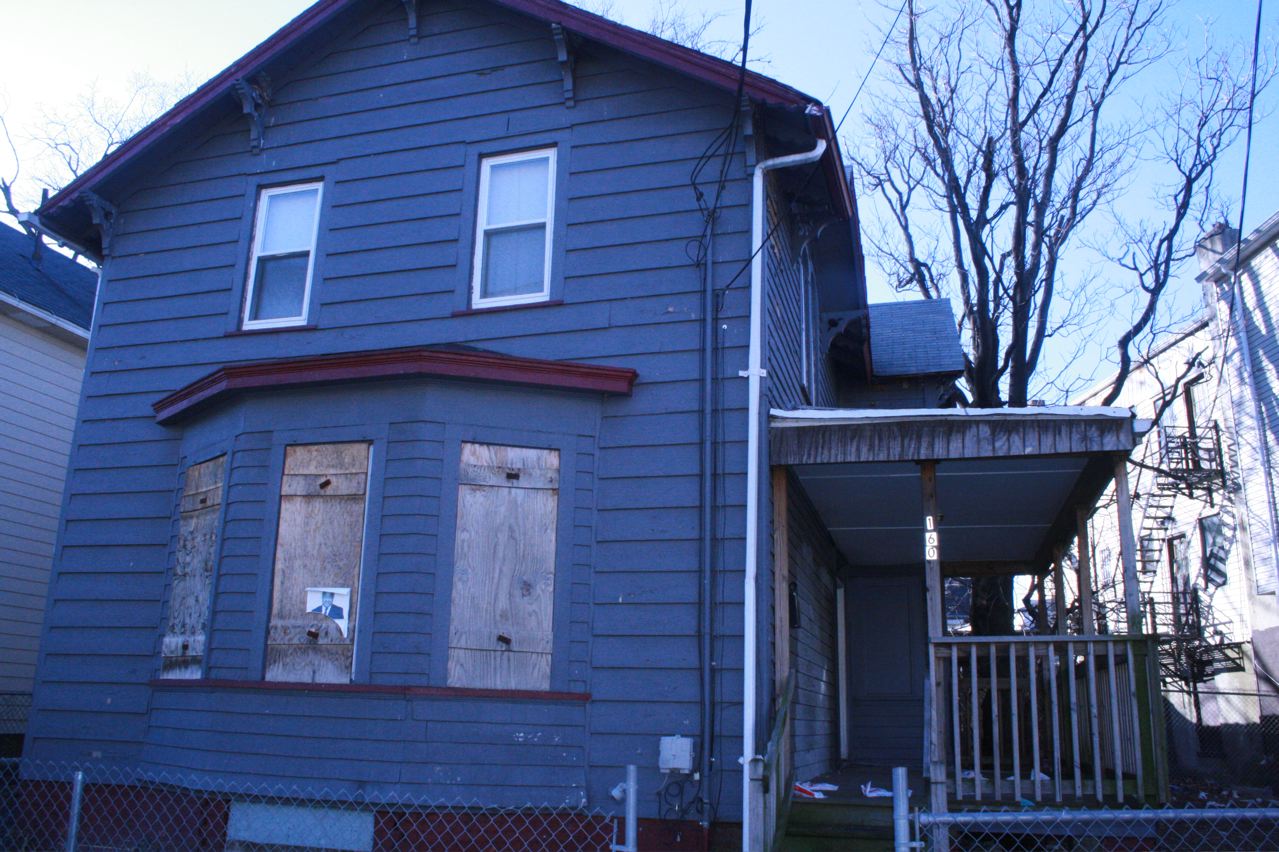
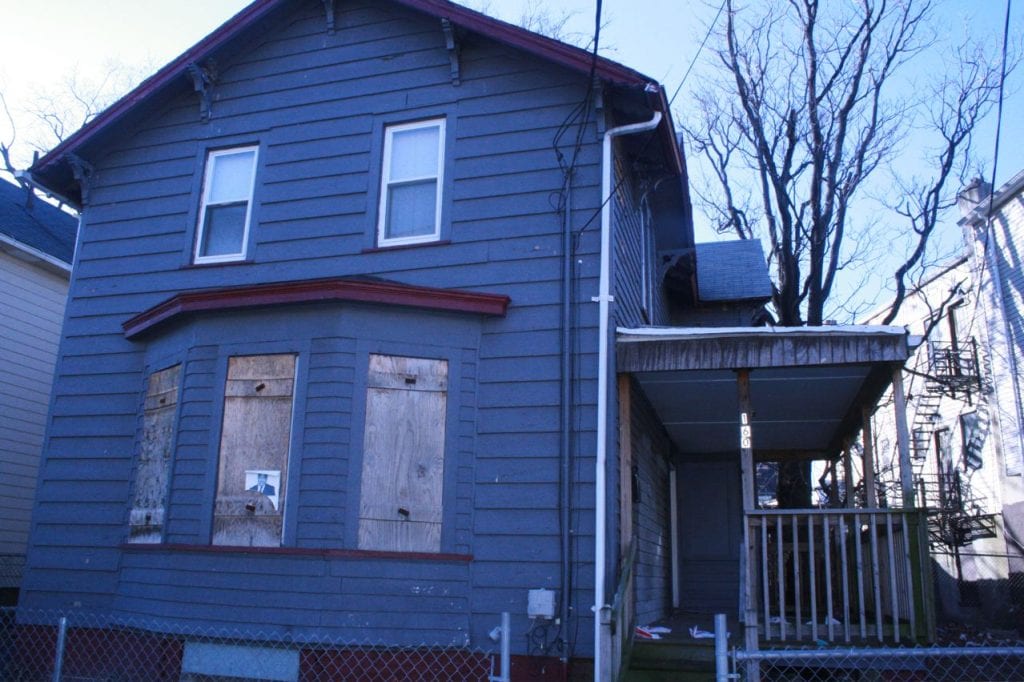
A foreclosed property in East Orange, New Jersey, and one of 47 properties involved in Operation Neighborhood Recovery. Photo by Matthew Hersh
Urban Essex County, New Jersey, one of the hardest-hit areas in the state by the ongoing foreclosure crisis, could be the laboratory for an ostensible reinvention of community development, as a local CDC there announced today the successful acquisition of 47 mortgages on troubled properties with an eye toward stabilizing neighborhoods in some of the oldest suburban communities in New Jersey.
The project, dubbed Operation Neighborhood Recovery (ONR) and spearheaded by the Orange, New Jersey-based HANDS Inc., is being touted as the first instance nationwide that a nonprofit organization has achieved that type of large-scale bulk purchase of mortgages. The properties, all vacant and abandoned, and many deteriorated, are located primarily in the New Jersey municipalities of Newark, Orange, East Orange, and Irvington.
The mortgage portfolio was purchased at a discount, roughly $50,000 per mortgage, according to Wayne Meyer, housing director at HANDS, from Washington Mutual Bank, which has since become JPMorgan Chase, for an anticipated total of about $5.4 million. New Jersey Community Capital, a Trenton-based community development financial institution, headed up the transaction, coordinating the debt and equity from financial partners that include Prudential Social Investment, LISC of Greater Newark and Jersey City, Neighbor Works America, and Enterprise Community Partners.
Patrick Morrissy, HANDS’ executive director, as well as National Housing Institute board member, credited existing CDC work, renovating, rehabbing, or developing housing with a particular purview, but pointed to the more regional scope of ONR. “The subprime mortgage crisis and subsequent economic fallout has caused the greatest downward pressure on urban neighborhoods that we have ever seen,” he said at a news conference unveiling the project, adding that “three decades of important neighborhood stabilization work is threatened and could be undone in a very short period of time.”
But Morrissy pointed to 16 collaborators involved in ONR that were pivotal in securing the bulk portfolio. Among the projects redevelopment partners include Brand New Day in Elizabeth, Unified Vailsburg Services Organization in Newark, Episcopal Community Development in Newark, HOMECorp in Montclair, the Greater Newark Housing Partnership, and La Casa de Don Pedro in Newark.
“Never in all this time have we come together with a single resolve that if we don’t work together, our individual efforts aren’t going to add up to enough to meet this crisis,” Morrissy said.
HANDS first made contact with then-Washington Mutual in 2007 looking to deal with the particular properties, but had limited success in making sustained contact with the bank, Meyer said. “But what we did was go to an auction that they were having and we bought a property.” Meyer noted that after that transaction, his group knew enough to make a proposal:
“We knew what the valuation was. We knew what the original mortgage was, we knew that what we paid for it and what they paid in cost.”
HANDS conducted a room-by-room renovations analysis, and arrived at a dollar amount for each house to get back to functioning use. Meyer said that only a handful of properties would need to be demolished because of their condition, and replaced with new houses. Of the properties acquired, 14 will be developed as market rate, intended to support the development of the other properties as affordable housing, Meyer said.
Having the financial partners, national community development intermediaries and a financial investment insurance company in NeighborWorks America, LISC, Prudential, and Enterprise, working together in a local context was a major facilitator in achieving the project’s financing, said Robert Zdenek, executive director of New Jersey Community Capital.
Michael Meyer, Newark’s director of housing and real estate, who also sits on the regional Essex-Newark Foreclosure Task Force, suggested the scale of the ONR project, as well as the partnerships involved, could prove to be a model for other localities, as well as presenting future potential when it comes to handling the estimated 900 REO properties that currently exist in Newark. “The scale of community reinvestment that is required to stabilize our neighborhoods is substantial,” he said.
“ONR is one more weapon we have in our arsenal,” said Gerard Haizel, executive director of Episcopal Community Development. ONR partners hope to use the momentum gained from this initiative to create a national model for a community asset preservation corporation, or CAPC.
The federal government’s Neighborhood Stabilization Program could supply additional funding for future projects, Newark’s Michael Meyer said, pointing to last summer’s $3.9 billion in emergency NSP funding, to be distributed to states and localities. New Jersey is receiving $64 million with some of the money funneled to localities, but with other projects seeking funds on a competitive basis as part of $2 billion marked for NSP II, where localities and states can come together in collaboration with nonprofits, as is the case with ONR, and apply director for those resources.
About the Author



Comments